A Day in the Life of a Software Engineer at Amazon
I’m a 26-year-old software engineer at Amazon in Madrid, and this is the realistic, 16-hour routine I use to balance Big Tech with my personal side projects.
I have spent many hours watching those “Day in the Life” videos on YouTube. I’ve been watching them since I was a student and dreamed about working in big tech.
Most of them are set in the US, usually featuring engineers in the Bay Area or New York.
While they are entertaining, I think people often miss the point that Big Tech is almost everywhere in the world. You do not have to be in Silicon Valley to have an interesting and challenging engineering career.
I’d like to bring that same energy to my newsletter. My goal is to provide a raw and realistic look at the Big Tech experience right here in Spain.
There’s no bragging intended in this post. I simply want to offer some inspiration and a personal connection to those curious about how we work and live in Madrid.
I wanted to try to write something different than usual, so I hope you enjoy it!
In this post, you’ll learn
The step-by-step daily routine of a Software Engineer at Amazon living in Madrid.
How I balance working on this newsletter with a full-time Big Tech role.
A small piece of my life!
5:50 - Wake up
My day starts while everything is still quiet. Some time ago, I’d wake up around 6:30 out of my own choice because it gave me a sense of control over my schedule. It was the only part of the day when nobody was asking for my attention, and I could focus entirely on my own goals before the corporate world woke up.
Now we wake up at this time because my girlfriend goes to work very early and she works in two halves. Her morning shift starts pretty early.
I’ve realized there are small habits I can make to feel more awake in the early morning
Drink lots of water
Get some fresh air, even if there’s no sunlight yet
Move myself or do some light exercise
After my girlfriend leaves, and depending on how tired I am or how badly I slept, I’d go to bed for one more hour or start my day.
7:00 - Start working in newsletter
I may still be a bit asleep, but that’s even an advantage. It’s the time my brain isn’t racing with so many thoughts.
From 7:00 AM until I have to leave for work, I dedicate my time to planning and writing for this newsletter. Besides working without distractions with a clear head, it’s the only time in my day that I have for a personal project.
I really try not to skip this block of work unless I’m too tired from previous days. It is a way to ensure that I am moving forward with my own projects alongside my main job. By the time I finish this session, I already feel like I have accomplished something significant before the official workday even begins.
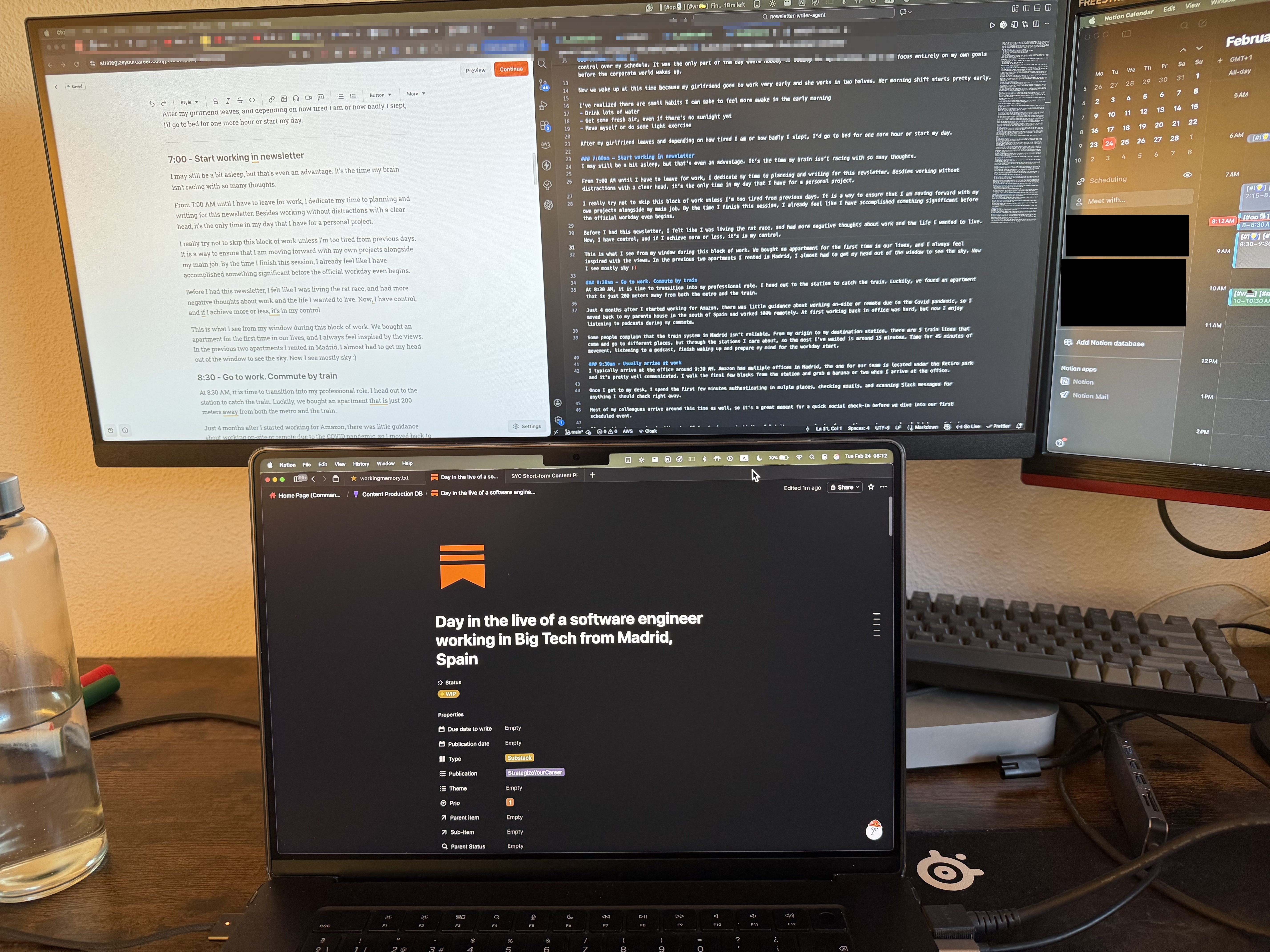
Before I had this newsletter, I felt like I was living the rat race, and had more negative thoughts about work and the life I wanted to live. Now, I have control, and if I achieve more or less, it’s in my control.
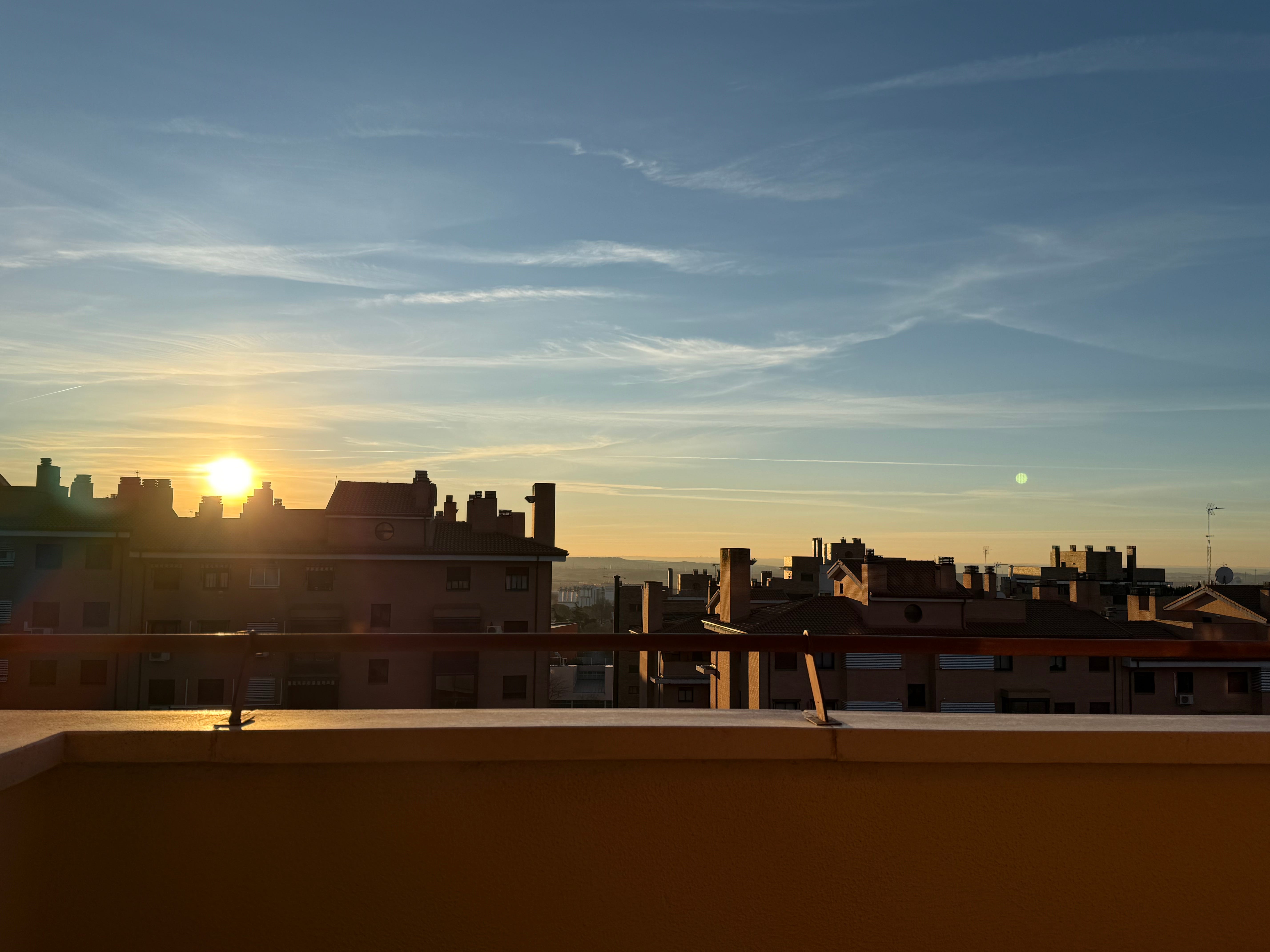
This is what I see from my window during this block of work. We bought our apartment recently, and I always feel inspired by the views. In the previous two apartments I rented in Madrid, I had to get my head out of the window to see the sky. Now I see mostly sky :)
8:30 - Go to work. Commute by train
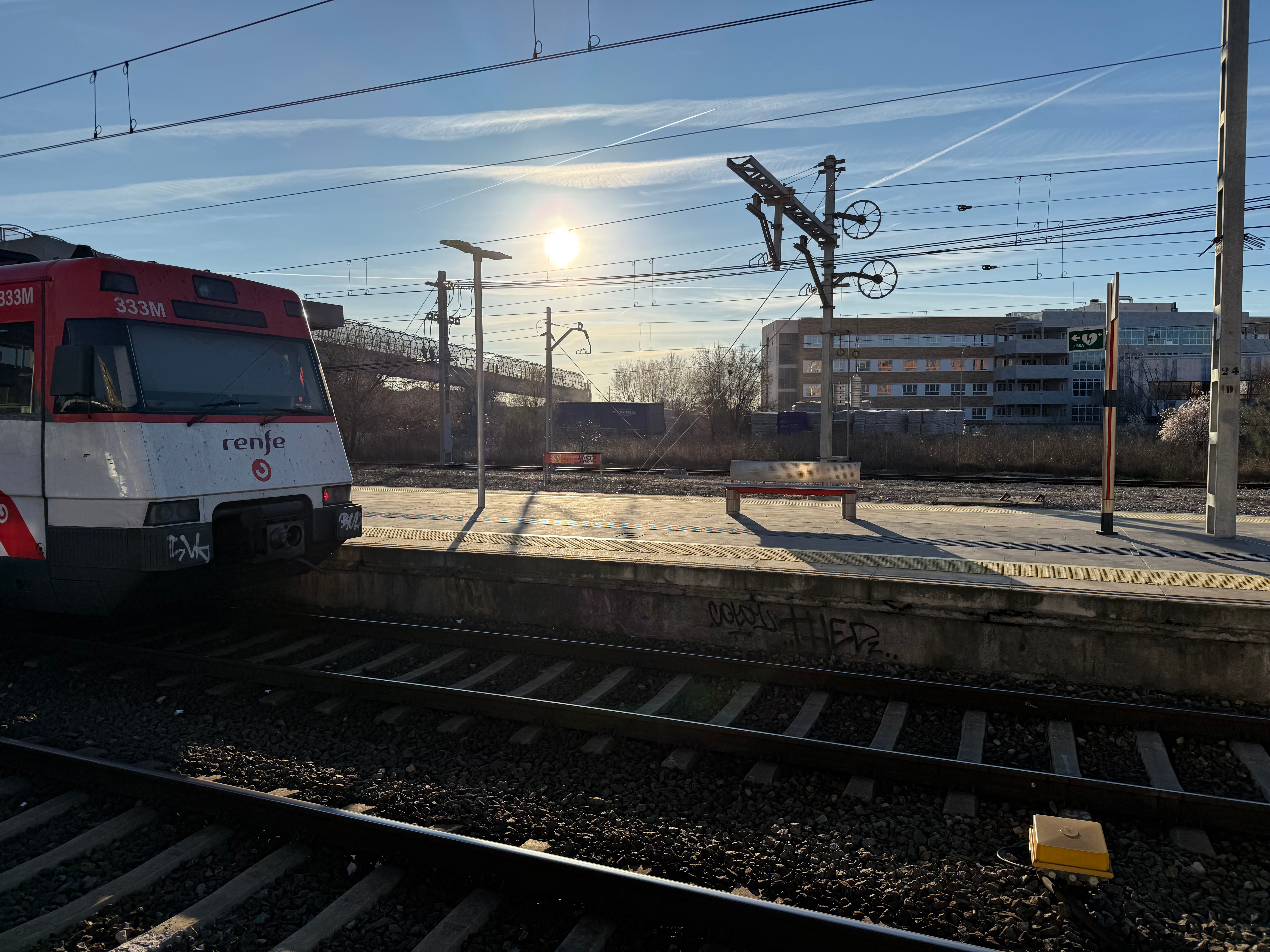
At 8:30 AM, it is time to transition into my professional role. I head out to the train station to catch the train. Luckily, we bought an apartment that is just 200 meters away from both the metro and the train.
Just 4 months after I started working for Amazon, there was little guidance about working on-site or remote due to the COVID pandemic, so I moved back to my parents’ house in the south of Spain and worked 100% remotely. At first, working back in the office was hard, but now I enjoy listening to podcasts during my commute.
Some people complain that the train system in Madrid isn’t reliable. It’s true they usually don’t meet the schedule. The good part is that from my origin to my destination station, there are 3 different train lines that can get me to the office, so usually I don’t wait too long.
Commuting takes around 45 minutes, so I have time ot listen to some podcasts.
9:30 - Usually arrive at work
I typically arrive at the office around 9:30 AM. Amazon has multiple offices in Madrid, the one for our team is located under the Retiro park, and it’s pretty well communicated. I walk the final few blocks from the station and grab a banana or two when I arrive at the office.
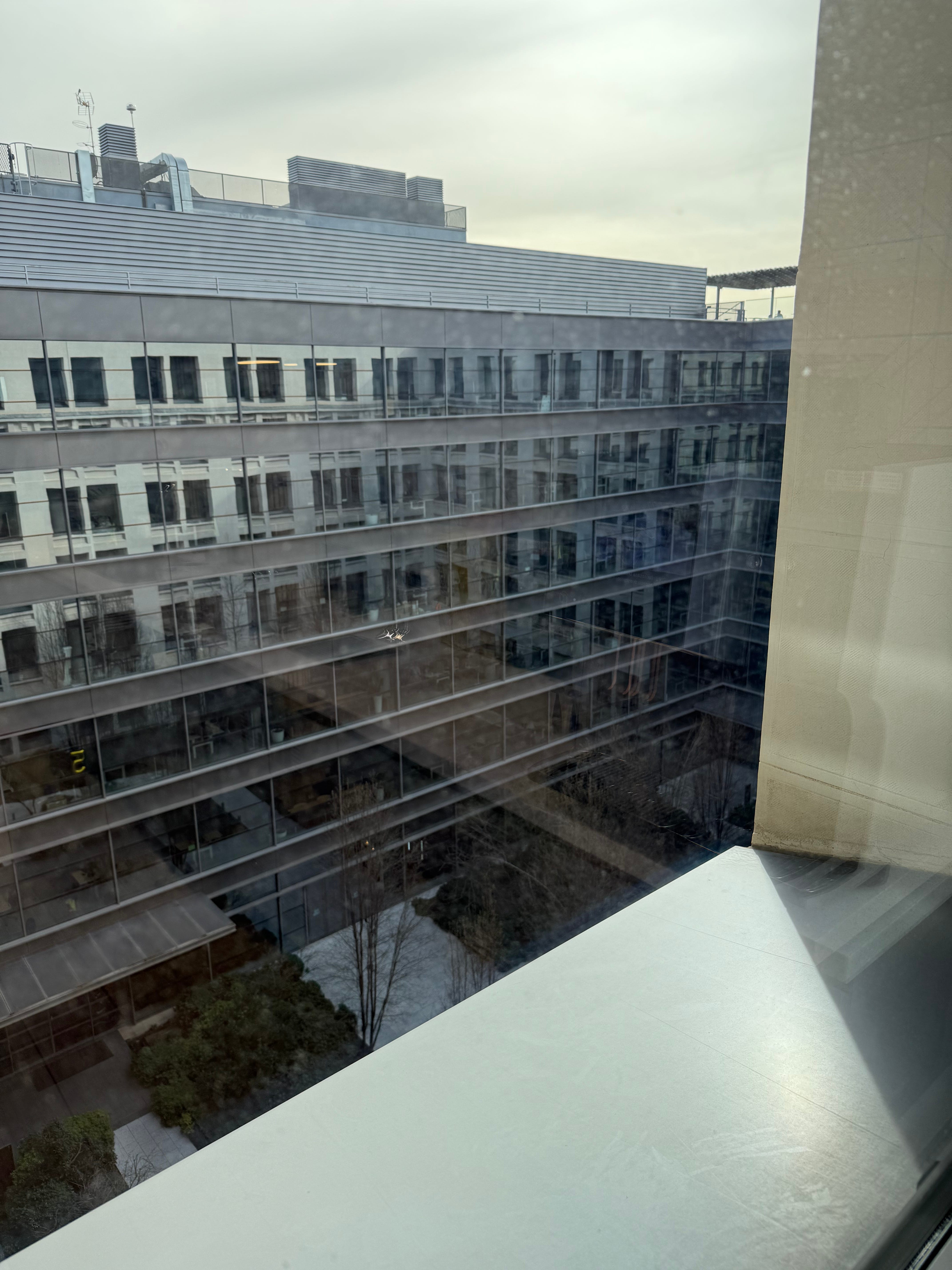
Amazon office is on only one side of the building, and in the middle, there’s a small garden. Here’s a picture of it
Once I get to my desk, I spend the first few minutes authenticating in multiple sites, checking emails, and scanning Slack messages for anything I should check right away.
Most of my colleagues arrive around this time as well, so it’s a great moment for a quick social check-in before we dive into our first meeting.
I’m starting to experiment with using AI Agents for productivity. I let it scan my calendar for meetings and scan a local database of tasks. My TODO-list was always growing, so I’m trying to use AI to manage my work better.
So I’d start asking my AI Agent: “Give me my daily plan for today.”
10:00 - Daily Standup
Our daily standup is at 10:00 AM. We discuss what we did yesterday, what we are working on today, and any blockers that might be standing in our way.
Most times, there are 1 or 2 pressing problems for the team. Sometimes they impact my work for today or not, but it’s always good to be on top of what’s going on for our team, not only for myself.
In the end, we don’t work on isolated projects. Anyone may need to work on any task, and we’re on-call for all our services, so it’s important to catch up.
11:00 - Work in the morning
After the standup and maybe some light meeting or 1:1, I dive into my first real block of work. I may start with a smaller block for some code review or a document.
The way I decide if I review something or not is based on the impact of that review: Am I blocking someone if I postpone doing reviews? If yes, I’d review the right way. If not, I’d start with my own work.
I’d like to say that I strategically design my work to work on the most complex thing in the morning, but usually I go with whatever is the next step in the work I have on my plate. I try to minimize distractions during this window to make the most of my morning energy.
I use the same trick at work and home: I put my phone behind the laptop’s screen. This way, I don’t have it visible, I don’t sense it in my pocket. But still, I’d hear a phone call if I’m expecting any (although most of the time my phone is in do-not-disturb mode permanently).
This is the time I do the most work of the day. Any longer team meeting is usually in the afternoon, and meetings with other teams are also in the afternoon. I work mostly with teams in the US, and their morning is my afternoon/evening.
In the breaks between letting AI run on a big prompt or waiting for a build to finish, I’d do code reviews or finish reading the Slack/email that I scanned earlier. I know, they are distractions to deep work, but sometimes the work I’m doing in the morning is mechanical steps to write a prompt, check a prompt, prompt again, check the build results after some minutes, etc.
13:00 - Lunch break
Our lunch happens at 1:00 PM. This is still super early for Spanish standards, but it’s the typical lunch time for corporate Spain. This is a very social time. Most of the teams gather in the office kitchen to eat. We are quite a few teams at Ring Madrid, around 5 engineering teams and other roles, so it’s a good time to mix and talk to other people.
I appreciate this cultural tradition of having lunch in a bigger group and stepping outside our desks. I’ve heard from colleagues that in other places, like London, it was typical to grab your lunch and eat it at your desk. Taking some time to step away from the screen and engage with otherhelps having a break in the day's schedule.
Most days, we bring our food from home. In some team events, we usually order paella!
Something I’d like to do more often is get off our floor in the office and walk outside, but most times I prioritize finishing work faster.
I don’t know about you, but for the last 1 year, our workload has only increased. The AI narrative, the layoffs... only put more stuff on our plates.
Especially as the building has a terrace that is open when there’s good weather. I often feel I’m not taking advantage of it. Here are some views from the terrace:
14:00 - Usually some meeting
The early afternoon is typically reserved for meetings. We put them right after lunch so we don’t break our focus. These can include any document reviews or Scrum ceremonies like retrospectives. I find that my energy levels dip slightly after lunch, so it is a good time to just relax a bit in a meeting and run some prompts in the background.
Something I’ve noticed is that since the AI took over the workplace, we have fewer meetings.
Maybe there’s less need to align when you can check with AI.
Maybe our team has been together for more than 2 years, so we are further aligned.
Or maybe we are skipping a bit of the processes. For example, we don’t estimate any more tasks for a sprint. It just doens’t matter, we have to deliver a lot of work regardless of whether we do sprint planning or not.
From a previous article, I talked about the PM triangle: There are 3 variables to deliver work: Scope, people, and deadline. If the deadline is fixed and, in theory, you can’t move it, you can reduce the scope or add more people to the project. So those two are the variables my team plays with most of the time, and moving the deadline is the last resort for some projects that have the freedom to move it.
I work at Ring, so our delivery as software engineers in the cloud team is one small part of a big Gantt chart. Our work blocks QA testing and manufacturing for devices, so deadlines are pretty strict.
Still, there’s a lot to negotiate in terms of scope and headcount.
15:00 - Back to work
By 3:00 PM, I am back at my desk for another session of focused work. I use this time to finish up the tasks I started in the morning and continue on the next thing. It pretty much looks the same: Work on the thing that is a priority, in the natural wait times like builds or AI inference, I’d check smaller pieces of work.
This is the time we start to get some interaction from other teams in the US. If I’m on-call or depending on someone else, it’s the time I can have a quick chat and unblock things.
17:00 - Most days some meeting with the US
This is when my colleagues in the US start their day. This is usually the time for any meeting with them. We sync up on projects involving multiple teams.
Once I finish any meeting or if I don’t have any, I’d take the time to read through some Slack channels and newsletters that spark my interest. Nowadays, it’s hard to keep up with AI, so I like reading Slack channels where people discuss the latest news in AI, their success stories, or other internal releases.
18:00 / 18:30 - Usual time to finish
I typically wrap up my workday around this time. I make a conscious effort to close my laptop and forget about work once I leave the office, so I’d rather stay 30 minutes more and finish the task than carry it home or think about it the entire day.
I’ve also been under tight deadlines and stopped maintaining a clear boundary between my professional and personal life. Every time this happens, I realize I have to get back to an equilibrium point, or I start feeling more tired and burning out.
I spent the last few minutes organizing my task list for the next day so that I can hit the ground running the following morning. Now with AI, I enjoy saying goodbye to my personal productivity agent, writing to it: “Let’s close the day!”
Once that is done, I head back to the station to get back home.
18:45 - Commute back by train
I use this time to decompress and let go of any stress from the day. While my morning commute is listening to a podcast, in the evening I usually walk in silence for a while until I arrive at the train station. My head just needs time without thinking about anything.
Once I’m at the station, I usually plug in a podcast until I arrive home. In the morning, I commute pretty “late” for Spanish standards, but around 7 pm, the train station is always full.
Some other days, I may commute in the middle of the afternoon and finish the last 2-3 hours of work from home. It depends on the meetings. I like that days look different, so I don’t fall into a routine that makes me bored.
Luckily, not all days are like the picture below!
By the time I reach my stop, I feel like I have successfully left the work world behind and am ready to enjoy my evening.
19:15 - Arrive at home. Do a light workout at home and shower
I arrive home around 7:15 PM and try to transition into a light workout. I have some home equipment, but you can do exercise with just your body and nothing else.
It does not have to be anything intense. I don’t try to get fit with these little workouts. I try to achieve two things with this block of time
Keep consistency in doing it every day.
Releasing any tension I have built up from sitting at a desk all day.
This little workout was more important when I was working 100% remotely. I had to move my body to signal to my brain that the workday was officially over. Can’t start reading a book or doing any other cognitive work just after the full workday
After my workout, I take a shower. This definitely signals the end of the day for me, and I’m much more relaxed afterwards.
20:00 - Girlfriend arrives home from afternoon shift. Dinner
My girlfriend arrives home at 8:00 PM from her afternoon shift. We take this time to have dinner together and catch up on our respective days.
We are conscious of having dinner together and not paying attention to our phones. In Spain, dinner is a slow and social process, and we try to honor that even on busy weeknights. It is the perfect way to reconnect.
21:00 - Watch Netflix or read in bed
By this time, we are usually done with dinner. We might watch an episode of a series on Netflix or just read for a bit. It is a low-energy activity that turns off our brain and prepare for sleep.
Many people obsess over blue light from screens. But I’ve found that what matters the most is just doing something that doesn’t make your brain or your heart move fast.
Besides being good to wind down and getting quality rest, I like having some time to catch up on TV shows, books, or just YouTube videos that I don’t have the time for through the rest of the day.
22:00 - Sweet dreams
At 10:00 PM, it is lights out. As we wake up pretty early, we definitely don’t have the typical Spanish schedule. Consistency is the key to managing our jobs and my personal project without losing my mind.
We definitely sleep less than we should in one go, so we are conscious about catching up in other ways. My girlfriend takes naps in the middle of the day between shifts. I do with an extra hour or two some morning, and we both definitely catch up on the weekends
Conclusion: Real Life
Madrid offers an interesting Big Tech life. You get to work on world-class problems with people from other parts of the world, just like in the US, while enjoying a culture that truly understands the value of time spent away from the screen.
My day doesn’t have any crazy plans, just repeating the things that work and I value: Work hard in both side hustle and main job, avoid a sedentary lifestyle with commute and exercise, time with my partner, etc.
Also, I’d like to call out that not every day is the same. I tried to highlight some of the most interesting things, but on many days, I’d just eat my own lunch from my floor’s kitchenette and get back to work quickly.
I hope this was useful to see a regular day in the life of a software engineer.
I would love to hear what a day in your life looks like. Let me know!
If you found value in this post:
❤️ Click the heart to help others find it.
✉️ Subscribe to get the next one in your inbox.
💬 Leave a comment with your biggest takeaway
I’m building this system below for paid subscribers. Thanks for your continued support!
🗞️ Other articles people like
P.S. This may interest you:
Are you in doubt whether the paid version of the newsletter is for you? Discover the benefits here
Could you take one minute to answer a quick, anonymous survey to make me improve this newsletter? Take the survey here
Are you a brand looking to advertise to engaged engineers and leaders? Reach out here
Give a like ❤️ to this post if you found it useful, and share it with a friend to get referral rewards
The fancy images are likely AI-generated, the not-so-fancy ones by me :)