Effective habits for software engineers
Stop grinding 12-hour days. Boost engineering productivity with systems, not brute force. Optimize health and leverage to 2x your impact without burnout.
Most engineers fall into a trap. They think productivity means staring at a screen for 12 hours.
Real senior engineering is not about working longer. It is about quality. It is about leverage.
This post is not just about writing code. It is about optimizing your cognitive performance.
Productivity isn’t about discipline. It’s system design.
In this post, you’ll learn
How to optimize sleep and diet for cognitive performance
Methods to raise the quality of your technical work.
Techniques to document your impact for career advancement
Health
Consistency over intensity: You cannot catch up on sleep debt. A consistent schedule works better. This improves how your brain solves hard problems.
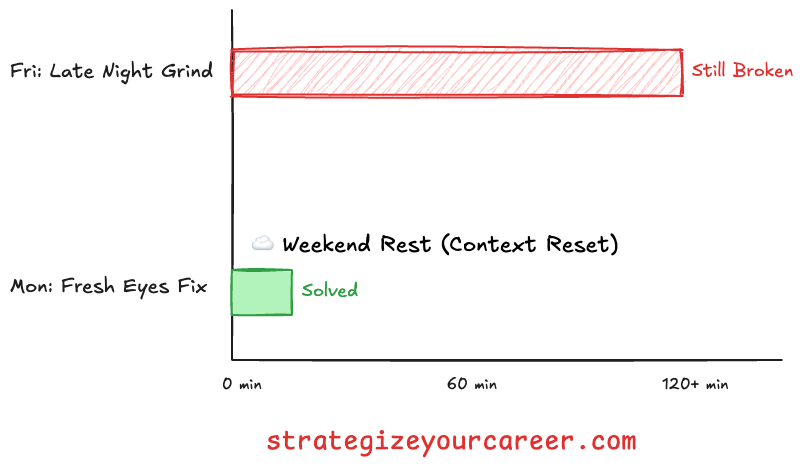
The “Sleep on it” debugging method: Spending two hours debugging on a Friday evening often yields nothing. Returning on Monday usually solves the problem in 15 minutes. Rest resets your context window.
Eat “Real” Food: Avoid the pizza and soda stereotype. Eat food found in nature, like vegetables, meat, or fish. This avoids glucose spikes that lead to afternoon brain fog.
Don’t Break the Chain of Exercise: Exercise is for mental clarity rather than muscles. It is better to do 20 minutes daily than to destroy yourself for 3 hours on Sunday.
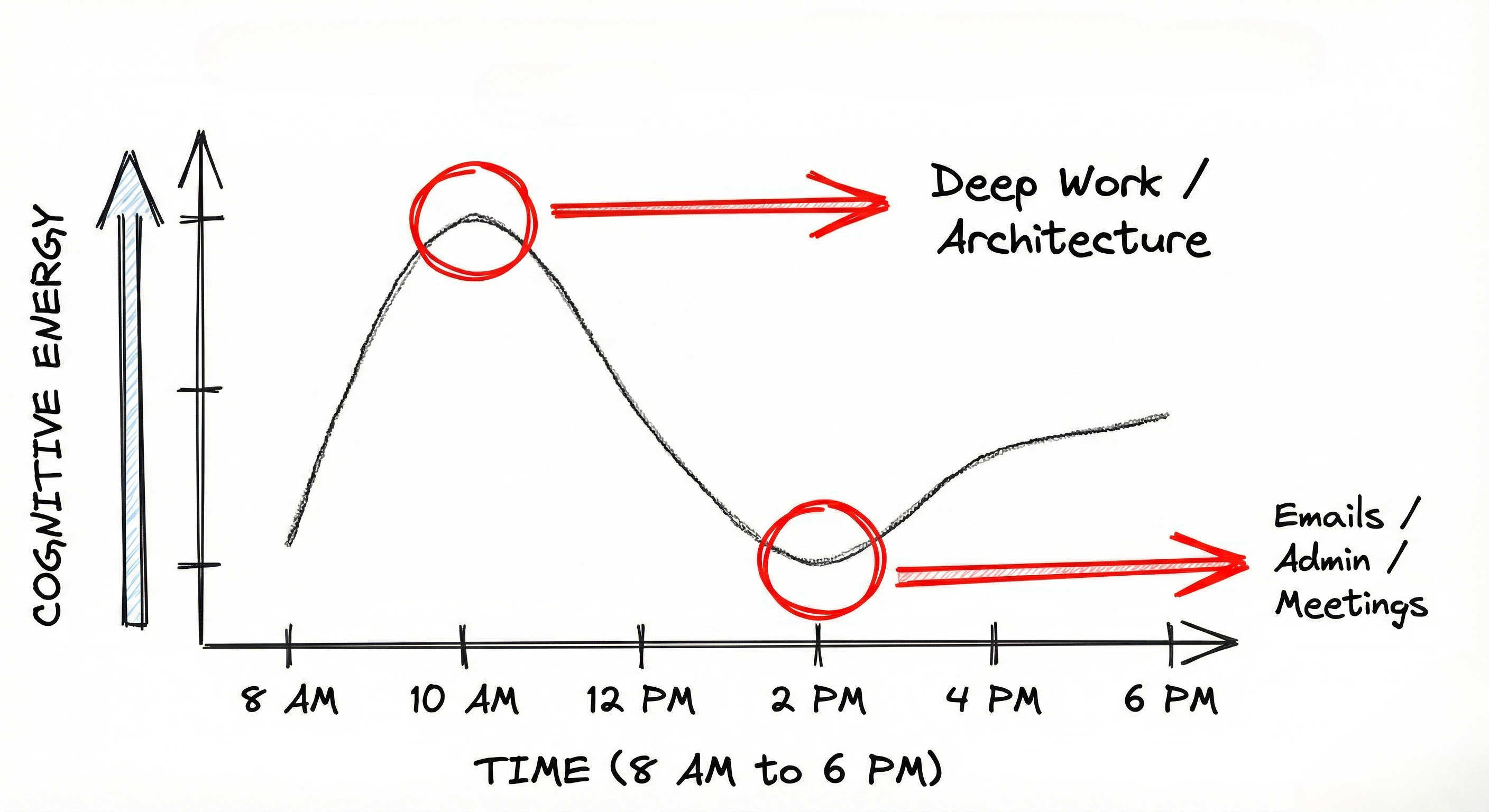
Energy management: Track your energy levels. If you peak at 10 AM, then schedule deep work at that time. If you crash at 2 P,M use that time for low cognitive tasks like admin or email.
Environment Design: Working from a cramped kitchen builds resentment. Optimize your desk setup to induce a flow state. Create an environment that you enjoy being in while working.
Technical
Don’t be a human linter: Automate style checks. If a machine can catch it, then a human should not waste calories on it.
Focus on the “Hard” stuff: Spend code review energy on design patterns, bugs, and non-negotiable changes. Prioritize boring and maintainable code over shiny new tech.
Read before you write: Prevent spaghetti code by understanding existing patterns. Spending half an hour reading can save hours of refactoring.
Data Structure Driven Development: Do not start typing code. Start with the data. Define the structures and flows first. The code becomes a trivial implementation detail. Code should be simple enough that you can draw the high-level flows on a whiteboard.
Shortest Path to Completion: Validate ideas before building. A 30-minute meeting to clarify requirements is better than four hours of coding the wrong feature.
Layered Debugging: Move systematically from outside to inside. Check service metrics, then database metrics, then logs.
Communication and career growth
Accountability, not Arrogance: Documenting wins helps you write your own promotion packet. Humans have short memories, so write down what you did. Regularly reflect on your progress, so you can refine your career strategy.
Commit Messages and Code Comments with “Why”: A sentence saying you fixed a bug or restating what the code does is useless. Explaining why that happened, why this was requested, or why this approach was chosen. Add context for the future you.
Learn “Just in Time”: Master the fundamentals like HTTP and SQL. Learn specific frameworks only when a problem demands it. Use AI to learn, not to avoid having to learn.
Rubber Ducking: Write down your steps before asking for help. You will often solve the problem just by articulating it.
Last words
High performance is a result of systems rather than brute force.
Even if your contract states the number of hours you must work, you are not paid for how many you work.
You are paid for the value you ship and the problems you solve.
This is leverage. You can increase 2x your impact without 2x your working hours.
Now, I want to hear from you. We all have different systems for efficiency. What is the single highest ROI habit you have introduced into your routine?
If you found value in this post:
❤️ Click the heart to help others find it.
✉️ Subscribe to get the next one in your inbox.
💬 Leave a comment with your biggest takeaway
This is an article inside our system to move between any phase. You’ll do your job faster with the right habits, and you’ll build the XP points necessary if you stop working mindlessly.
I’m building this system for paid subscribers. Thanks for your continued support!
🗞️ Other articles people like
👏 Weekly applause
Here are some articles I enjoyed from the past week
Ownership is where many engineering careers stall by Adler Hsieh . Seniority is defined by what you own. You need to stop just checking off tasks and start taking responsibility for the messy parts.
96% engineers don’t fully trust AI output, yet only 48% verify it by Gregor Ojstersek . There is a dangerous gap between skepticism and action. You cannot outsource your professional judgment to a model. The one responsible when things fail is you.
Coding challenges - does AI write good code? let’s find out. by John Crickett. AI is a tool, not a replacement for a rigorous engineering process. You must still use linters and compilers to ensure your code is actually production-ready instead of just looking correct.
P.S. This may interest you:
Are you in doubt whether the paid version of the newsletter is for you? Discover the benefits here
Could you take one minute to answer a quick, anonymous survey to make me improve this newsletter? Take the survey here
Are you a brand looking to advertise to engaged engineers and leaders? Reach out here
Give a like ❤️ to this post if you found it useful, and share it with a friend to get referral rewards
The fancy images are likely AI-generated, the not-so-fancy ones by me :)


Nice post, and thanks for the shoutout!