

Get the free AI Agent Building Blocks ebook when you subscribe:

Most engineers begin the year with high hopes and specific targets. By February 15th or earlier, most have dropped their goals already. This happens because we focus on the wrong things. We look at the result we want rather than the habits required to get there.
Survivorship bias clouds our judgment regarding success. We often assume that ambitious goals are the cause of high achievement. The reality is different. Winners and losers usually share the exact same goals. Every junior engineer wants to become a senior engineer to earn more money, be more employable, and work on more interesting problems. Every startup founder wants to go public, have a liquidity event, and be on the Forbes list. If the goal is the same for everyone, the goal cannot be the factor that makes the difference. The system is what separates the winners from the losers.
When you focus solely on a specific target, like launching a feature, you work hard until you finish it. Once you cross that finish line, you stop moving, at least until you have your next yearly review and set up a new yearly goal. True career growth does not have a finish line. It is a cycle of endless refinement. It’s an infinite game: One of those games where the entire purpose is to keep playing, not to finish a particular tournament, not to win a particular prize. This year, we are replacing motivation with protocols, ignoring the current scoreboard, and focusing entirely on the ball and the direction we want it to move.
In this post, you’ll learn
Why focusing on leading indicators is more effective than setting lagging goals.
How to distinguish between your identity and your daily inputs.
The method for building confidence through small, consistent actions.
Strategies to maintain your health while pursuing career growth.
The philosophy: Vision vs input
You must distinguish between your identity and your protocol/systems. James Clear describes the trap of momentary change. You might clean a messy room or refactor a messy codebase. That provides a momentary result. If you do not change the sloppy habits that caused the mess in the first place, you will find yourself back in the same situation a month later.
You cannot control the result of getting promoted. You can only control the input of your daily standard. Take, for example, a fast-growth engineer. Their bad lagging goal is to earn a specific salary raise amount. The good leading input is the Deep Work protocol. This involves reading and summarizing relevant technical concepts, and tracking how to apply them at work, for sixty minutes a day. You track the concepts you apply rather than the money you earn.
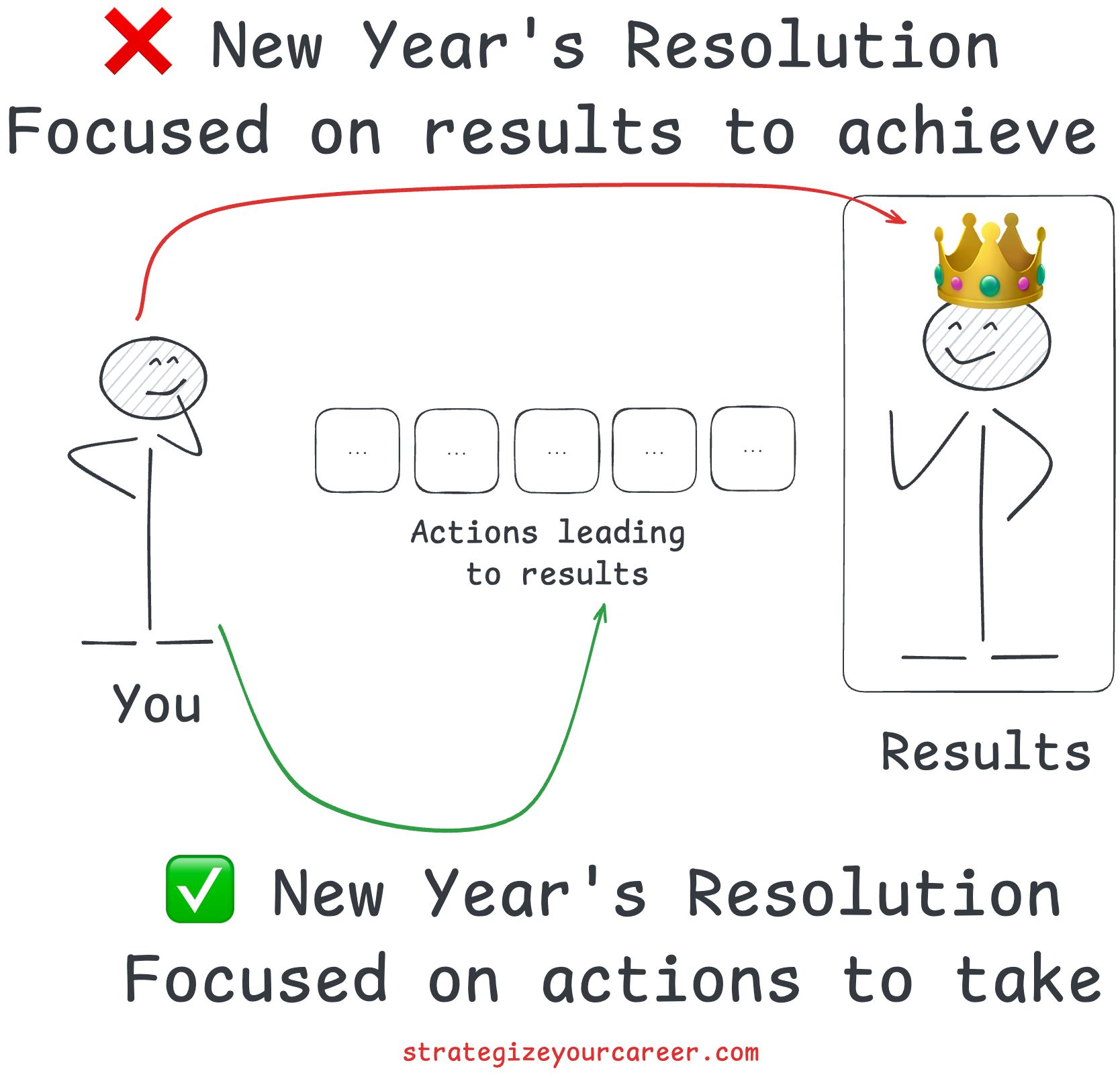
Maybe this is clearer with someone focused on their health. Their bad lagging goal is to lose a specific amount of weight. The correct leading input is a frequency protocol where they work out for fifteen minutes five times a week. Completion of those workouts is the only metric that matters; the results when weighing themselves come as an inevitable consequence.
The rule here is simple. You cannot “do a promotion”. You can only do a daily protocol. When you fix the inputs, the outputs will often fix themselves.
Pick an identity (and stop postponing happiness)
Many engineers fall into a happiness restriction trap. You tell yourself that you will be happy or successful only after you become a staff engineer or earn a certain amount of money. If you fail to reach that level, you feel like a disappointment. If you succeed, you simply move the goalpost to the next achievement and remain unsatisfied.
You should consider an exercise I first heard from Ali Abdaal regarding “designing your ideal week”. The goal is not to imagine a fantasy life as a millionaire on a remote island. You must imagine what an ideal Tuesday looks like in your current job. I realized my ideal day involved a workout before heading to the office. In reality, I wasn’t doing that. This highlights the gap between your actions and your desired lifestyle.
The shift requires you to choose an identity. Do not set a goal to write a book. Decide to become a person who writes every day. You must define your own vision rather than adopting the vision of your employer or parents.
I’ve finished my yearly review. This year, I used ChatGPT more, and it proved surprisingly useful. The same why as asking “5 whys” in a postmortem helps uncover root causes, chatting with an AI helped me uncover blind spots in my self-assessment.
🔒 Premium subscribers have access to the template I have used for more than 5 years for yearly reviews. Read until the end to get it.
For many areas in this year’s review, I thought my bottleneck was a lack of time. The review with ChatGPT revealed my actual bottlenecks were different, like fear of failure, or a lack of clarity on the vision. We all have blind spots we don’t see, chat with another person, or with AI. Once you focus on the protocols, you give yourself permission to be happy from today because your system is running correctly in the present.
The “success spiral” (winning by design)
The most common failure mode for engineers is setting ambitious goals, not knowing how to close the gap between the goal and their reality, and doing nothing, dropping the goal. This is often driven by imposter syndrome and a simple lack of clarity about how to achieve the goal. This makes us lose trust in ourselves. We close easy tickets to justify our salary, and we close many of them to justify our busyness and lack of time.
The solution is to build what Nick Winter calls a success spiral. Confidence is not a personality trait. It is a reputation you have with yourself. You build this reputation by keeping small promises. You stop asking “Can I achieve this huge goal?” and start asking “Can I execute this tiny input?” This shift moves your focus from a scary outcome you can’t control to a small action you can. This allows you to prove your capability to yourself over time.
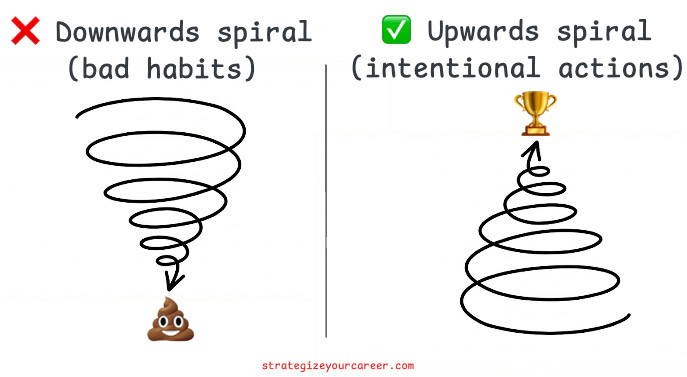
For example, a lagging indicator you want is a promotion to senior or staff level. A possible input is dedicating the last twenty minutes of your day to investigating something no one asked you to do. You could dive into the source code of a dependency. You could read a product requirement document for the next quarter. You could clean up a flaky test.
The rule is to make the goal stupidly small. It should be so small that failing is impossible. If you sit down to do it, you achieve it. It’s not about “am I capable of achieving this?”, but about “am I disciplined to do this every day?” You focus strictly on the input of time spent or days doing this action, rather than the output of bugs fixed. Instead of waiting until you feel like it, you tell yourself you are doing this so you can feel better later.
After ten days, you have built a success spiral. Your identity shifts from a task executor to a codebase owner. Promotion follows the identity you established years prior. This is the real “fake it until you make it“: Do the right actions, then results will follow.
The wheel of life check
You must be careful not to let your career success spiral create a death spiral in your health, relationships, or other life areas. In your early career, one unit of effort often yields one unit of result. Later in your career, you face diminishing returns where one unit of effort may only yield half a unit of result. Pushing harder without a strategy is not sustainable.
Sometimes, the highest return on investment activity for your code quality is sleeping eight hours. Don’t set protocols only for professional purposes. You need a health protocol and a relationship protocol to manage this balance.
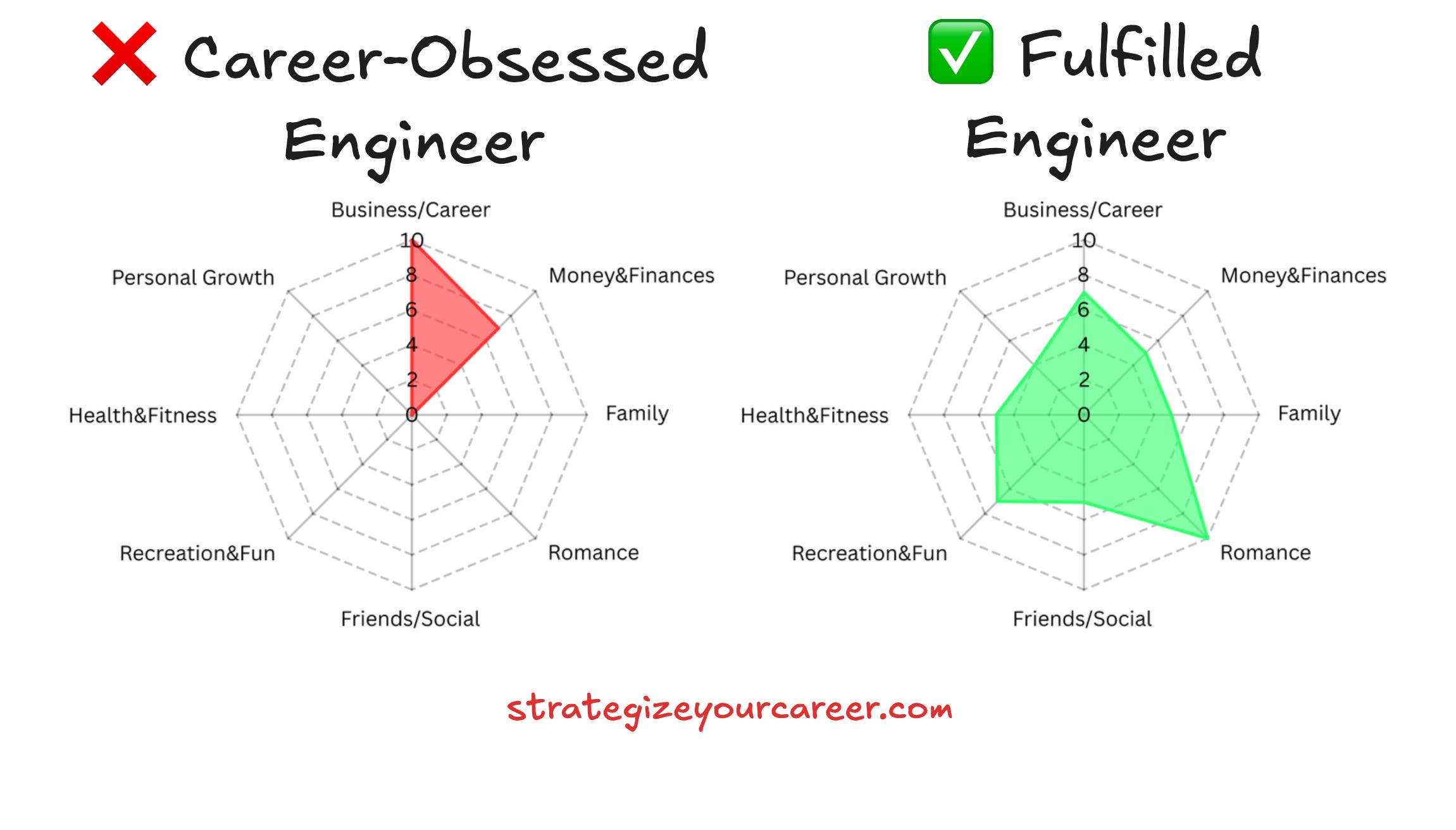
That’s why I create an explicitly “maintenance” list. I decide which areas, such as travel or hobbies, are in maintenance mode this year. This prevents me from feeling guilty about not doing everything at once.
If you want to dive deeper into the concepts of this last section, like reviewing past year and planning next one, maintaining a balance between areas, and choosing which ones to push and which ones to keep on hold, become a paid subscriber to check last year’s article about yearly reviews here (it’s the second most popular article in the newsletter)
Conclusion
Consider your life as a black box system. Inputs go in. Time passes inside the black box. Outputs come out. You cannot control the internal mechanics of all life areas; they are too complex. Sometimes it looks like a monkey controls those mechanics. You can only control inputs.
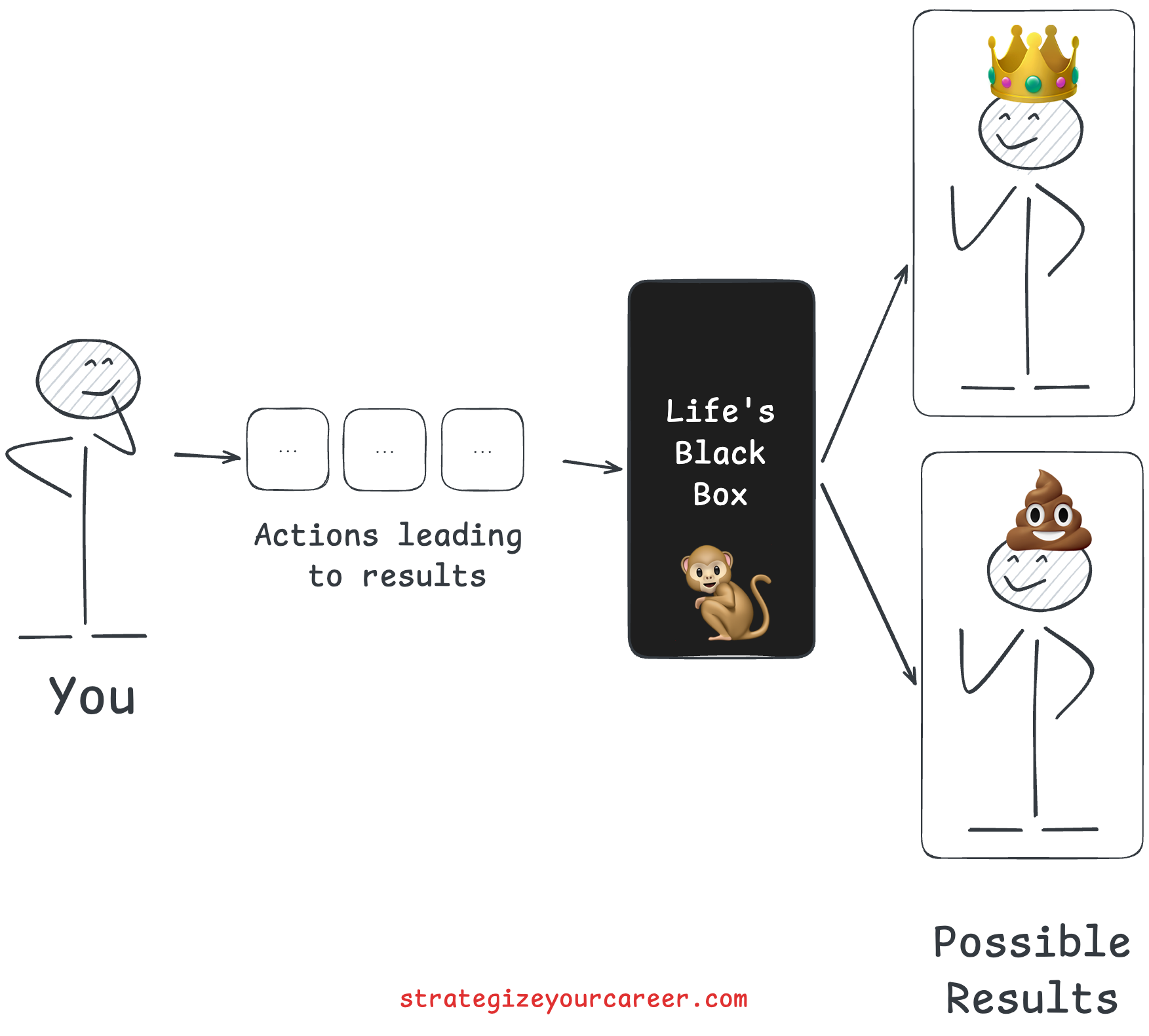
To summarize the approach for 2025, define your identity to avoid postponing your happiness or trying to achieve someone else’s vision. Second, forget about goals at all. You must install protocols instead. Third, use success spirals based on small inputs to build your confidence and get closer to the results you envision in your vision.
Do not wait for January 1st to start. Decide on your protocols and start trying them these days. I did my yearly review 10 days before the end of the year so I have time to be overly optimistic, realize some protocols won’t work, and adjust them before January 1st.
P.S. Don’t let this be another “Read-Only” article. The gap between knowing you need a protocol and running one is where most engineers fail.
To ensure you execute in 2026, I’m offering a limited-time 25% discount on the annual plan. This isn’t just about unlocking more articles in this newsletter; it is immediate access to the implementation layer, which includes systems like:
Yearly Review System: Define a clear vision and protocols
Productivity Workstation System: Work every day on the right thing, and build your success spirals.
Time Tracking System: Tell yourself the truth and eliminate low-ROI work.
Claim 25% Off Annual plan. Let this be the last push to start your Success Spiral. Offer ends in less than a week
(Paid subscribers can scroll all the way to the bottom to get the template and instructions)

🗞️ Other articles people like


👏 Weekly applause
Here are some articles I’ve read last week and liked:
Hungry Minds by Alexandre Zajac. My go-to source to discover good software engineering content.
Multiple Places Where Caching Exists by Saurabh Dashora. Caching is pervasive across the entire stack. I was just debugging for half an hour on a personal project, and that wasn’t syncing my changes… it was my browser’s cache 🙃
Meatspace Jailbreaks by ToxSec. I hadn’t thought about the way to “hack a Tesla“. Vision-only autonomous systems are very brittle. I just remembered the famous video where a Tesla crashes, but a Waymo doesn’t on a wall painted like a landscape. I’m beyond excited with videos of Tesla cars driving in Madrid, Spain, where I’m located, and hope they make it soon to production… but securely.
P.S. This may interest you:
Are you in doubt whether the paid version of the newsletter is for you? Discover the benefits here
Could you take one minute to answer a quick, anonymous survey to make me improve this newsletter? Take the survey here
Are you a brand looking to advertise to engaged engineers and leaders? Book your slot now
Give a like ❤️ to this post if you found it useful, and share it with a friend to get referral rewards
The fancy images are likely AI-generated, the not so fancy one by me :)