

Get the guide to build your first AI agent directly in your inbox with a newsletter signup:
I want you to picture two people.
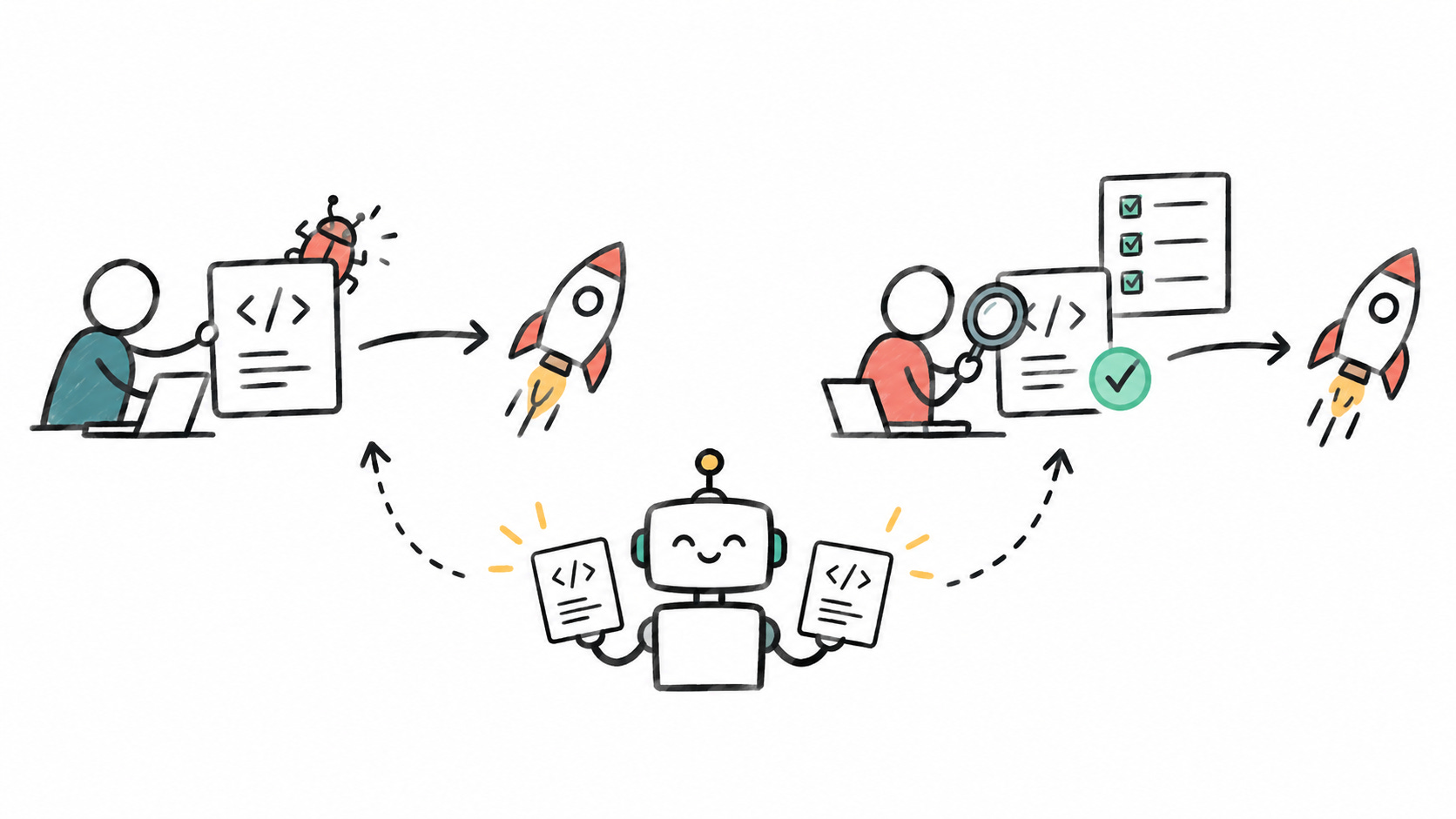
The first one is a very experienced engineer who is always advocating for following best practices. Someone who has been in the company for a long time. And someone that you actually trust, like you look up to them regarding their code quality.
The second one is a new hire who doesn’t have much experience and doesn’t have any experience in the company. Someone who is starting to write their first contributions in code. And you have seen that they are lacking some of the mental models that this company requires.
When you arrive at work in the morning, you realize that you have one code review from each of these people. And let’s say that those code reviews are more or less the same complexity. Which code review would you spend more time on?
In theory, if AI had already reached the point to replace all software engineers and we were already into AGI. Provided that both people have the same models available, you would just say that both should be the same level of trust. But the reality is that no, you are trusting the experienced engineers more than the new engineers.
So, if both people are using the most powerful model and we still trust one more than the other, why is that happening?
👉 If this sounds interesting, subscribe now. 22,000+ engineers are already becoming more productive. Paid subscribers have access to premium resources
AI-first software engineering still needs a human standard
So many people think that they are AI-first engineers just because they are using AI. I think nowadays in 2026, everybody is using AI.
Where I think we’re making a mistake is when we think that we can ask it, “Build me an iOS application”. And the AI will make all the decisions and don’t need any supervision over it. And just the code will be good.
It’s great that the AI is removing and abstracting you from many micro decisions that otherwise you would have to make. However, the AI abstracting you doesn’t mean that the AI is making the best decision all the time. This is where your judgment comes into play.
Now think about someone who, instead of asking the AI, “Build me an iOS application”, used AI to investigate what the best practices of iOS development are. Someone who put the AI to work and made it ask the most important decisions. And someone that made the AI surface what are the trade-offs and the architecture decisions that it’s taking in order to approve or reject.
The difference will be clear, and not only in the actual output, the actual artifact, but also in the understanding and the learning that the person behind the AI is having.
It’s not about not using the AI; it’s about using it but not making it play against you.
Sometimes when I interview candidates, some of them tell me that they are proud of not using AI in the actual code. They say they only use AI to write unit tests or to write documentation. They may have thought that the answer I was looking for was not to use AI. But the actual answer to the AI problem is not avoiding having to think hard about how to make AI work for you. The actual answer is making AI work for you, building everything around the AI.
I know that there are a lot of people who are against reading AI-generated articles. I’m not personally against it, but at the same time I know that it’s hard to build trust if you write everything with AI. That’s why I’m writing this manually.
But take, for example, two articles. The first one was from someone who had been doing a lot of research. Someone who built their own software. Who tried, failed, and tried again. Someone who had the hard-earned scars of experience. And then that person told the AI to write an article from all those learnings.
Now take a second person who just told AI, “Hey, write me an article about whatever topic”. It can be true that the actual syntax is similar, you know, because AI is having the same patterns. AI is repeating the words in the same way. But I will trash the first-person article, and I will actually read it. And I will just trash away the second person’s article.
The reason is simple. It’s not about how much time it took you to write the article. It’s about what authority and credibility you have to actually write about it.
The same thing with PRs. I will trust the senior engineer’s PR more than the junior engineer’s PR. Both use AI to generate the code, but I trust the person behind it differently.