

Get the free AI Agent Building Blocks ebook when you subscribe:

I produce quality work faster by using my time well, and so do you.
I rely on deep work and smart tools to deliver results. My day is structured around high-impact tasks and scheduled recovery. I have learned that output matters more than clocking hours.
The 40-hour workweek was designed at the time of the Industrial Revolution, one that no longer fits the needs of software engineering. Multiple countries in Europe are leading the charge, reducing work hours.
In this post you'll learn
The origins of the 40-hour workweek and why it's obsolete for software engineers.
How to apply the science of deep work to maximize your productivity.
Practical strategies for leveraging AI to automate tasks and free up time.
How to achieve a better work-life balance through focused work.
#1 The History of the 40-Hour Workweek (And Why It’s Becoming Obsolete)
The 40-hour workweek has its roots in the Industrial Revolution, when 10-16 hour shifts were common. Labor movements fought for an 8-hour workday, and Ford’s adoption of the 40-hour workweek in 1926 became a standard, later codified by the 1940 Fair Labor Standards Act in the U.S.
However, this model was designed for factory labor, not knowledge work like software engineering. Europe is moving away from the 40 hours. Countries like France and Denmark have already implemented shorter workweeks, and Spain is proposing a 37.5-hour week by 2025. These changes show that a shorter workweek can support better work-life balance and efficient output.
Software engineers don’t need 40 hours to be productive—we need focused work. As I like to say, “What I’m measured for is the output I produce, not the hours I’m around.”
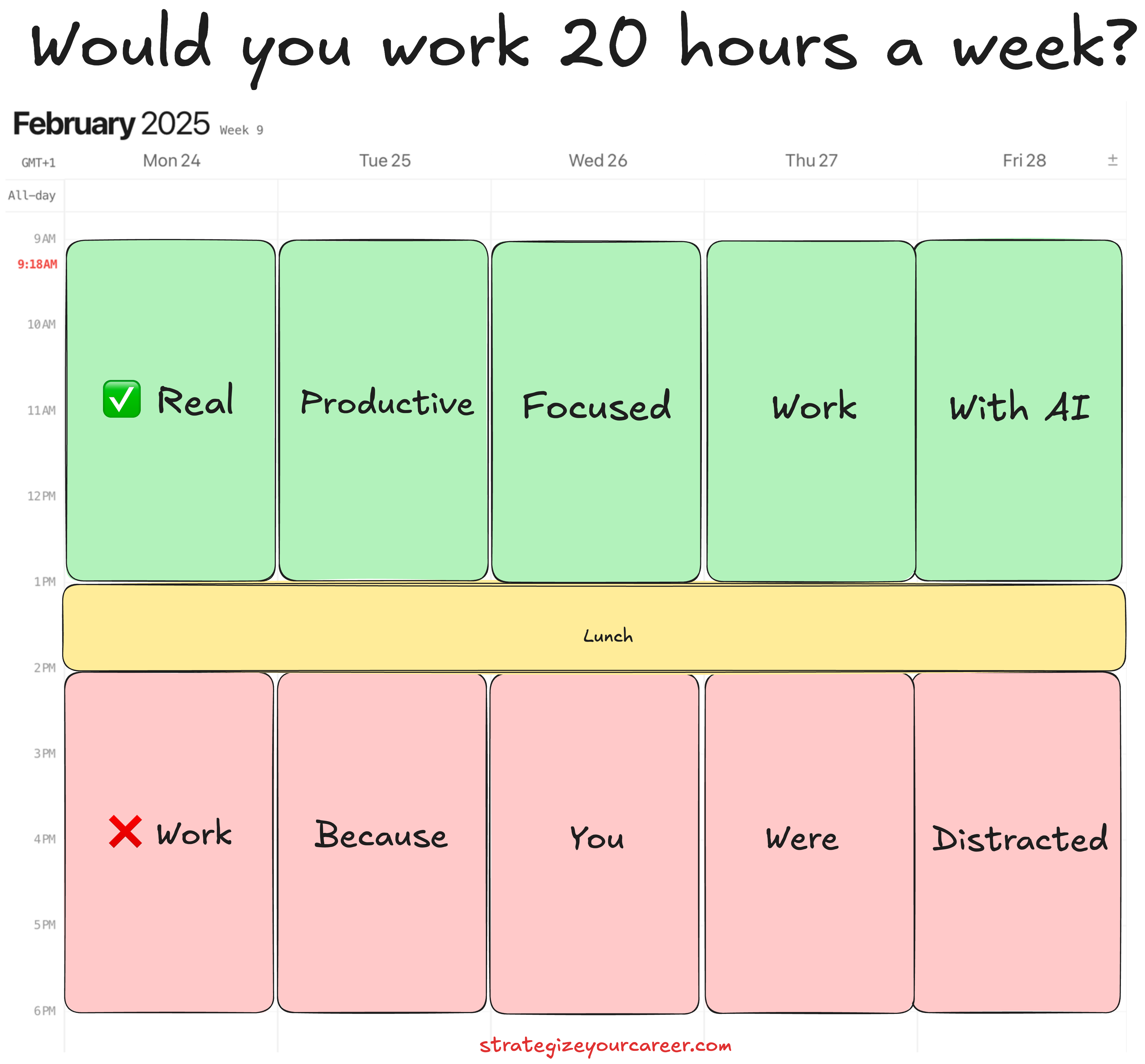
#2 The Science of Working Less but Achieving More
Deep Work, as defined by Cal Newport, suggests you can only sustain 4-5 hours of focused, high-impact work per day.
Most people waste too much time on shallow work. To maximize deep work, start with 60-90 minute sessions, reduce distractions, and balance intensity with recovery. Sessions over 90 minutes often yield diminishing returns. I've seen that beyond 90 minutes, my mind tends to slow down, and productivity falls off.
AI and automation can free your time for high-impact work. Many engineers still waste time on low-value tasks. AI can automate administrative work, letting you focus on critical thinking. I am super productive since AI became part of my workflow.
Before, I would have been the human in charge of googling the docs of a framework, using an online conversion tool for JSON formatting, or writing all my code for the machine to execute. Now I'm one step back, telling a machine to write code for another machine to execute.
Most engineers aren’t limited by time; they’re limited by how they use their time. With AI, you can ensure you block time for walks, naps, or hobbies to recharge.