

👋 Get the guide to build your first AI agent directly in your inbox on newsletter signup:

Many talented engineers feel stuck despite working harder every year. You might master a new language or memorize the intricacies of a new framework, but still find yourself plateauing in your career. Promotions feel harder to reach. The frustration builds because you assume the bottleneck is technical skill.
We often mistake productivity for typing speed or the ability to recite documentation from memory. True engineering throughput is not about how fast you write code. It is about how effectively you solve problems and navigate ambiguity. The barrier preventing you from reaching the next level is rarely the code itself. It is the Fixed Mindset.
Paradoxically, this mindset manifests in two opposite ways.
You might suffer from Impostor Syndrome, where internal shame prevents you from asking for help.
You might display the Dunning-Kruger effect, where arrogance makes you reject feedback.
Both behaviors stem from the same incorrect belief that your intelligence is static and you don’t consider the need to keep learning. By shifting to a Growth Mindset, you stop protecting your status and start optimizing for results. This transforms you from a fragile coder into a resilient leader.
In this post, you’ll learn
How Impostor Syndrome and the Dunning-Kruger effect stem from the same static belief system.
How AI was a big disruption that required a growth mindset
The difference between defending your code during reviews and improving the overall system.
How to apply the Snapshot mental framework to navigate career growth.
Two faces of the same problem
The Fixed Mindset is a trap that forces you to view your ability as a static binary. You either have it or you do not. This belief system creates two distinct profiles that seem different on the surface but share the same root cause.
The engineer who internalizes failure as a character flaw. (Impostor Syndrome)
The arrogant engineer who blames others to protect their ego (Dunning-Kruger effect)
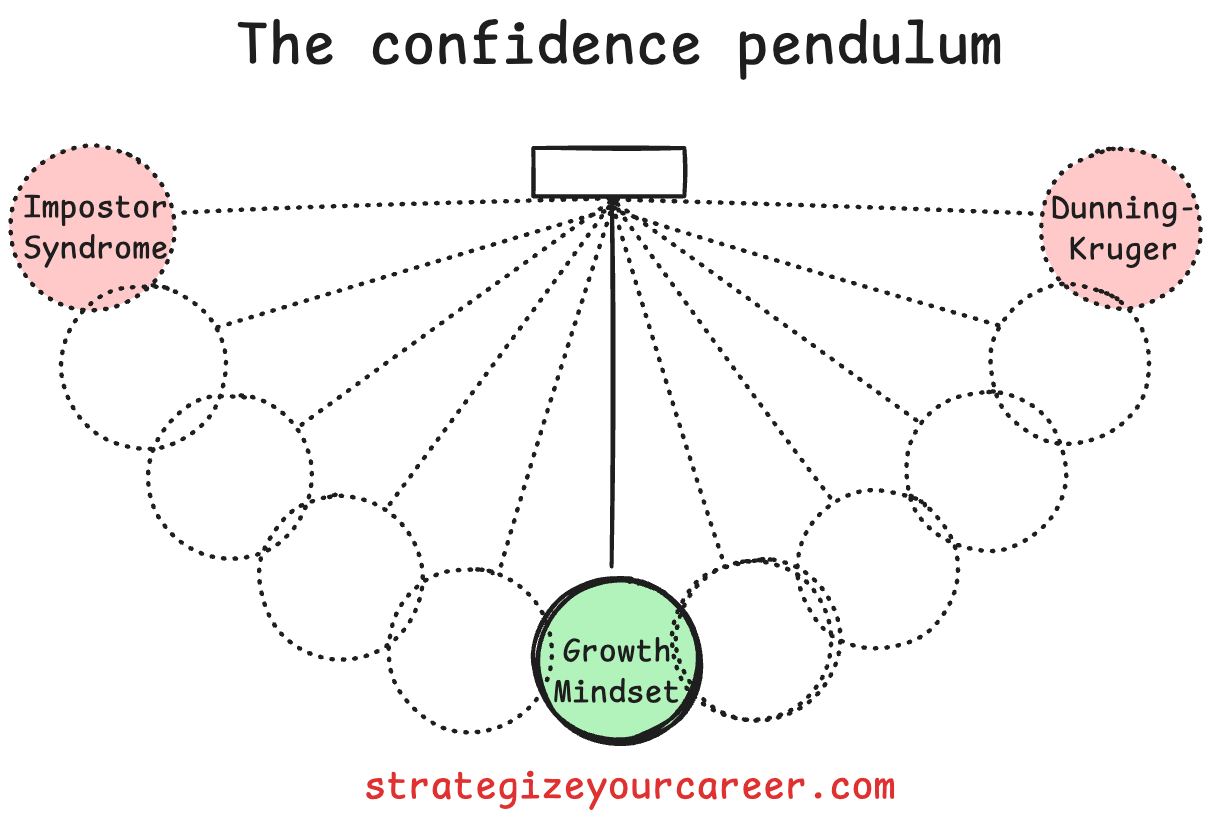
Consider this common scenario: