

Software engineers have a great career opportunity in front of them.
Being the one who knows about AI in your org is a great role, much better than being the one who knows about any other technology. This career edge doesn’t come from “innovating” or discovering anything new. It comes from noticing that something already works outside your company, then making it safe and useful inside your team.
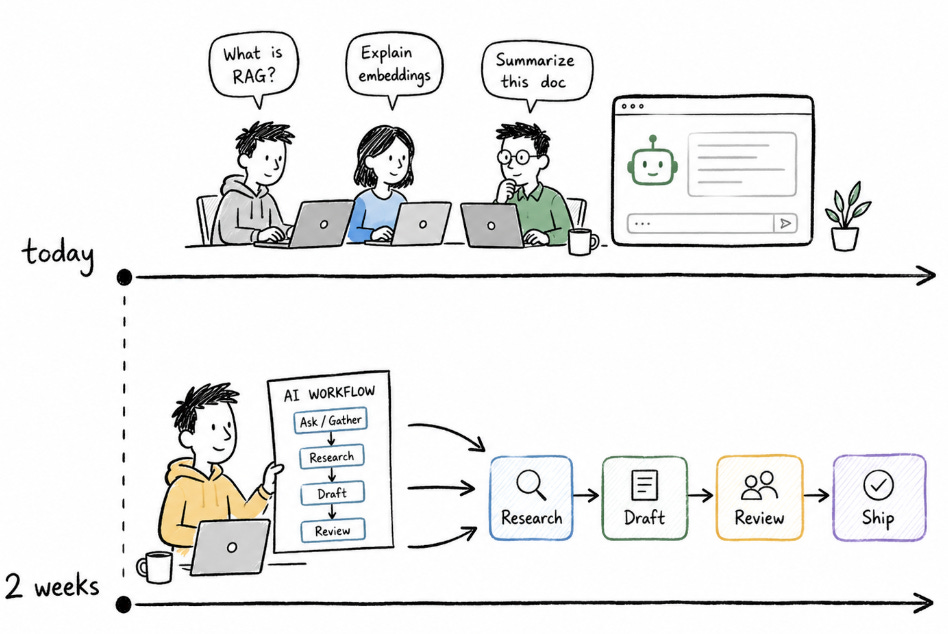
You don’t need a PhD in AI for this. You just have to be a couple of weeks ahead of your peers.
The public debate is obsessed with frontier models, coding agents, benchmark scores, and whether AI will replace developers. You will be the one who realizes that inside a normal engineering org, the more practical question is which recurring task can you improve this sprint, prove with real artifacts, and turn into a workflow other engineers can copy.
The edge for software engineers is adoption, not invention
Most companies are already full of engineers using AI both at work and in their personal lives. They use it to explain code, draft messages, summarize docs, generate tests, and review their decisions. But this usage does not automatically become team impact.
The gap appears when one engineer turns a private trick into a shared process. You can start simple with a prompt in your notes that helps you with a recurring process. The gap for most engineers is moving from personal productivity to engineering leadership.
This is why the “2-week edge” I talked about matters. You do not need to be years ahead of the industry. You need to be slightly ahead of your local environment, then translate that lead into something your team can trust. When an AI term becomes mainstream, you’ll have already introduced a proven process in your team.
Start with the work nobody wants to write
The best AI workflow to start is usually not code generation. Code changes have too much hidden context, too much review burden, and too much risk when the author does not understand the output. There’s a reason why software engineers have been very well paid.
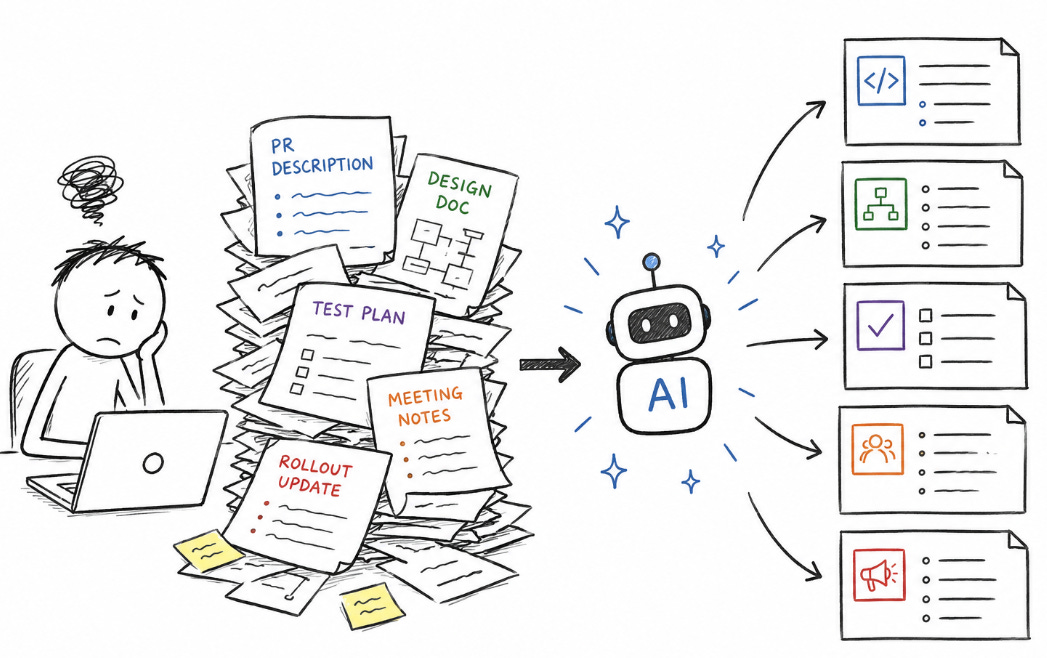
So start with the artifacts around the code. PR descriptions, design doc drafts, incident timelines, migration updates, test plans, on-call handoffs, and stakeholder summaries are better first targets. They are frequent, annoying, easy to compare, and safe to review.
Since the very first team I’ve worked on I’ve heard the same complains from engineers: “We have too much meetings”, “we are writing too many docs”, “we don’t have visibility on priorities”. These aren’t complaints about writing code. They are about everything else around the code. So you have a big opportunity in there.
Sending meeting notes takes minutes. A bug in prod can create a huge effort for the next few months. That difference matters. Only after you get used to working with AI for these first workflows, only after you prove to your leadership that you can create value with AI, you can jump into the difficult problem of setting a coding standard with AI.
The simplest test is to take something from last week that humans did manually, or something that was semi-automated. Use a real meeting or a real doc. Try your AI-assisted workflow against it, then compare the new output with the artifact your team actually used. If the new version is clearer, faster, or easier to review, you have evidence. Start getting these small wins.
The workflow is the work artifact
When I’m interviewing candidates, and I ask about their use of AI, I see a pattern across many of them. Saying “I’ve heard about Claude” or saying “I ask Claude to create agents and figure out” is the same. It tells which tool you opened, but it does not show judgment, repeatability, or team value. Everybody can use AI tools at the user level. We’re looking to become power users.
The workflow is an artifact for your promotion or your next interview. It should explain the task, the input, the expected output, the review rule, and the boundary where the human takes over. With those pieces, you have something a teammate can run without you. You moved from personal productivity to a team impact.

For example, an engineer can use AI to generate PR descriptions. You just have to ask your AI, and it will generate something. The useful part is setting it automated, connecting the necessary tools for context, and having evals that catch regressions.
Those guardrails are where engineering judgment appears. AI is just another technology where we have to apply our engineering judgment. It’s not enough to “just use it”.
Make the before-and-after impossible to ignore
Don’t pitch AI adoption with hype. Show the old artifact vs the new artifact.
Imagine you come and say in a team meeting: