

Get the free AI Agent Building Blocks ebook when you subscribe:

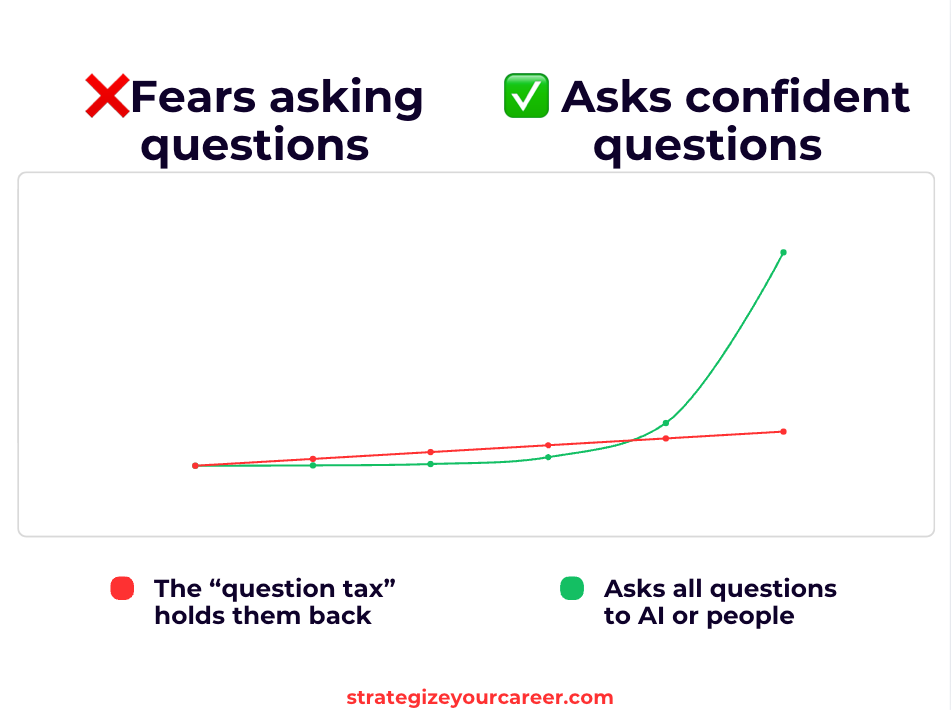
The best software engineers all share a secret: they ask a lot of questions. Yet as we progress in our careers, many of us develop an aversion to asking "dumb" questions. We fear judgment from peers or appearing incompetent to managers. This fear creates a "question tax"—a hidden cost that dramatically slows professional growth.
Ever held back a question because you didn't want to look inexperienced? You're not alone. The paradox is that the best engineers ask the most questions. Yet, many engineers waste hours trying to figure things out on their own rather than risk exposing a gap in their knowledge.
AI has fundamentally removed this question tax. With AI assistants like ChatGPT and Claude, we can ask anything without fear of judgment, creating a massive opportunity to accelerate our careers. The engineers who leverage this technology to embrace "productive ignorance" will outpace those who continue to pretend they know everything.
⭐ In this post you'll learn
Why the fear of asking questions holds back your career
How AI enables question-driven learning without social friction
The role of iterative questioning in building strong mental models
Why question formulation is becoming a key engineering skill
🧠 Career Killer: The Fear of Looking Dumb
Impostor syndrome affects nearly every software engineer, regardless of experience level. This self-doubt creates a cycle of silence: when we don’t understand something, instead of asking questions, we nod along and promise ourselves we'll figure it out later.
Traditional team dynamics often discourage questioning. In standup meetings, there's pressure to report progress, not confusion. In code reviews, we hesitate to ask fundamental questions for fear of appearing like we lack basic knowledge. In architecture discussions, we stay silent rather than challenging assumptions that might expose gaps in our understanding.
The real cost of not asking questions extends far beyond momentary discomfort. Misconceptions persist unchallenged, becoming embedded in our mental models and eventually in our code. Wasting time on incorrect approaches because of unasked questions is a major career bottleneck. The fastest-growing engineers are the ones who overcome this hesitation.
🤖 AI as Your Judgment-Free Learning Partner
AI eliminates the social cost of asking questions. Junior developers can ask the same basic question multiple times without bothering senior team members. Seniors can revisit fundamentals without risking their status. AI serves as a frictionless, always-available mentor.
The psychological safety of a non-judging learning partner changes everything. You can ask from a question a highschool student would ask and follow-up with a question more suited for a college professor, building your understanding layer by layer. This iterative questioning helps build comprehensive mental models that connect abstract concepts to practical applications.
I still remember when someone with far more experience than I challenged something I asked with a “Come on, this is a basic full-stack development concept“. Yet, thanks to questioning the basics, we found it wasn’t working as expected. This didn’t stop me from continuing to ask questions, but at the time I felt vulnerable.
By systematically questioning AI, you create a personal knowledge base. Before meetings or code reviews, you can use AI to fill knowledge gaps, asking about unfamiliar technologies or design patterns. This preparation boosts confidence and reduces the impact the impostor syndrome has on us, allowing you to participate meaningfully in discussions that would otherwise feel intimidating.
I learned this early at Amazon: The best engineers aren't the ones who know everything, but the ones who either answer directly or find the answer and get back to you. Now with AI, these engineers can find those answers quicker.
🛠️ Question-Driven Development
The shift from "knowledge hoarding" to "questioning mastery" represents the future of software engineering. The most valuable engineers won't be those who memorize algorithms or framework syntax. They'll be the ones who can ask AI: "What edge cases would break this API design?" or "How might this system fail under load?" The quality of your questions will differentiate you more than the facts you store.
Debugging is faster without social debt. Instead of posting a vague question in a team channel, you can test five hypotheses with AI in ten minutes before bringing your best ideas forward. I’ve pasted entire files into Claude and it created test cases and scenarios I hadn’t considered. This allows me to focus on reviewing and refining, catching bugs before they hit production, instead of focusing on the syntax to inject a mock in the constructor.
The ability to ask precise, well-researched questions should become a key hiring metric. That was already present in leetcode-like interviews, and I believe this will increase over time. The engineers who can systematically identify and investigate the right questions will have a competitive edge.