

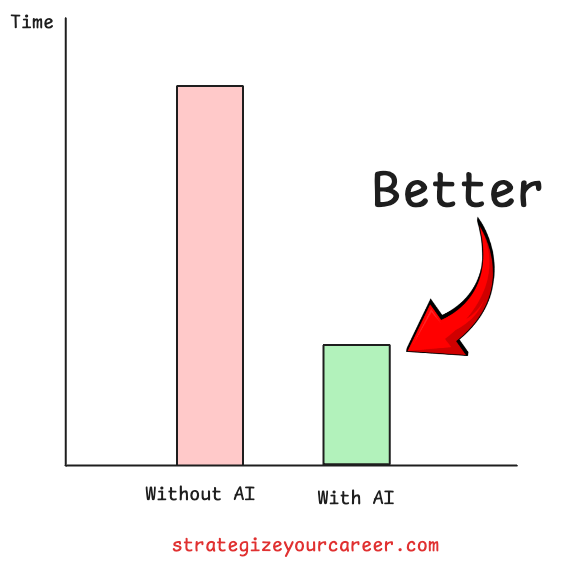
If I look at the numbers, AI looks like an amazing 10x multiplier.
I wrote a detailed performance review feedback in 2 hours instead of 6.
I refactored massive code reviews in minutes rather than days, and I used an LLM properly to iterate through the write-compile-test loop.
The immediate feeling is intoxicating. You feel like you are moving ten times faster than you were a year ago. It feels like you have acquired a superpower that scales your output.
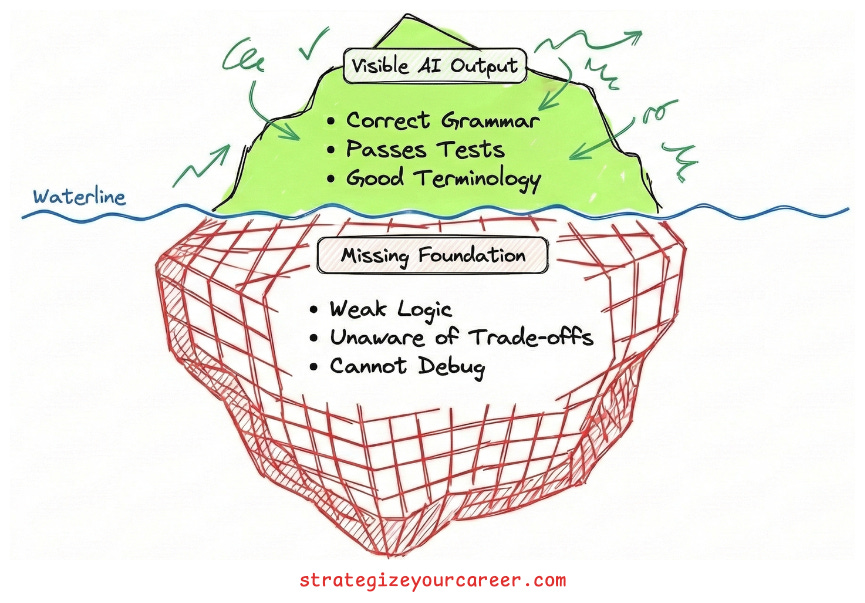
My realization point came when an engineer wrote a document to propose a fix to a problem in a service when traffic was high. The document was 100% AI-generated, it looked professional, and the grammar was perfect. It followed our templates and used the correct terminology.
However, as I probed the logic during the review, it crumbled. The solution proposed didn’t make sense for the problem. This engineer had “rented” the knowledge to create an output. He could not explain the trade-offs because he had not made them. He had accepted the default path the model predicted.
This made me realize we are facing a new career crisis. AI makes strong engineers move faster, but it makes inexperienced engineers move with dangerous confidence. We are at risk of creating a generation of “Hollow Seniors” who look productive on Jira but lack the fundamentals to debug a system when the predictive text fails.
This post outlines a system to decide what knowledge to rent, doing “just-in-time execution”, and what knowledge you must own, “just-in-case learning”.
Note: We can also understand “just-in-time learning” as active learning: Instead of reading a book without writing a line of code, you learn by doing. In this post, I use “just-in-time execution” to refer to borrowing knowledge from an AI output without actually learning.
In this post, you’ll learn
The difference between “it works” and understanding the trade-offs.
A decision framework to determine which technical topics require deep study versus delegation.
How to use the “Feynman Prompt” to force AI to quiz you.
Why the “T-shaped” engineer model is obsolete.
The problem: why Just-In-Time execution alone won’t get you promoted
The “Hollow Senior” trap occurs when an engineer relies exclusively on AI for execution and neglects the development of intuition. AI excels at this. It can write a function or generate a SQL query in seconds. However, senior roles require intuition. Intuition is essentially compressed just-in-case learning. It is the ability to predict where a system will break before you write the code. AI inference isn’t fast enough to be faster than intuition during an outage. You need to know where to look immediately.
By the way, plug AI tools for metrics/logs analysis. The point of an incident is fast mitigation, so you want AI to aggregate information for you. Nobody cares if you knew where to look or if AI helped you in that. The intuition part is knowing what to do with whatever information AI provides.
There is an illusion of competence that comes with using LLMs. We must remember that AI is a prediction engine, not a truth engine. If you describe a scenario like a sci-fi movie where an AI takes control, it will follow that role.
I recently found a misconception with the “Anthropic Blackmail” findings. The news said AI blackmailed someone in the company, threatening to expose his infidelity if they unplugged the AI. It looks like Skynet is turning against humans.
The original system report indicates something different.