

Get the free AI Agent Building Blocks ebook when you subscribe:

Want to grow your career faster? It’s not about chasing "big break" moments.
The most successful engineers don’t wait for perfect conditions—they build tight feedback loops and iterate rapidly to create them. Career growth isn’t about grand, one-time efforts. It’s about compounding small, smart improvements through continuous learning and iteration.
If you keep operating within the same flawed system, no amount of effort will lead to real progress. Just like in The 7 Habits of Highly Effective People, where Stephen Covey emphasizes sharpening the axe before cutting down trees, you need to focus on improving how you work rather than just working harder.
In this post, we’ll explore why system optimization beats brute force, how small wins lead to major breakthroughs, and the practical steps to refine your workflows for long-term career success.
⭐ In this post, you'll learn:
How to shorten feedback loops to improve learning and iteration.
Why small, incremental wins drive sustainable career growth.
How to optimize your workflows instead of repeating ineffective habits.
Practical ways to automate and refine your processes for better efficiency.
1. Optimize Your Feedback Loops for Faster Growth
The faster you get feedback, the faster you improve. Engineers who shorten the time between writing code and receiving validation accelerate their learning and impact. It’s a virtuous cycle that sets you up for success.
One of the most effective ways to speed up feedback loops is by improving your development environment. Using your favorite AI-powered tools like GitHub Copilot, cursorAI or any other for instant code suggestions and setting up hot-reload for live debugging can save you hours of manual work. Automating local testing with unit tests and pre-commit hooks ensures you catch errors early before they snowball into bigger issues.
Another game-changer is implementing CI/CD pipelines. Every code change should trigger automated tests and deployments, giving you immediate feedback on whether your changes work as intended. Feature flags let you test updates with a subset of users, reducing risk and allowing for quick iterations based on real-world usage.
Once we have the tech tool in place, the human becomes the bottleneck. Tightening feedback cycles with async and real-time code reviews helps you catch mistakes early and learn from your peers. While I haven't done pair programming, having fast syncs with people who leave feedback, even before starting to code, provided me an immediate knowledge transfer and improved code quality.
2. Small Wins Compound into Big Career Growth
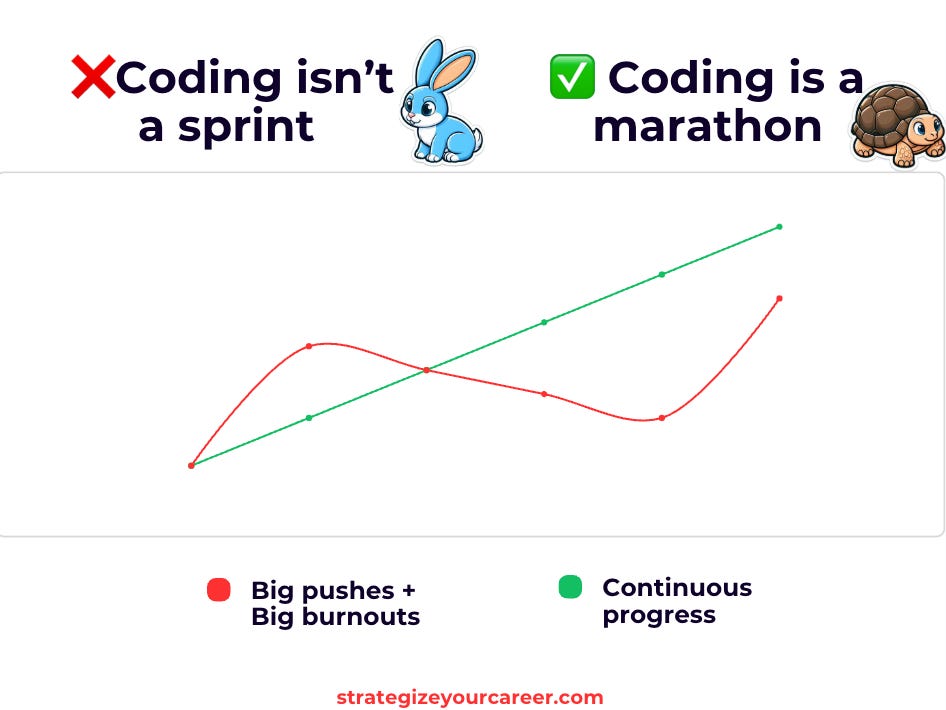
Solving one problem per day adds up to massive improvements over time. Small, visible wins increase credibility and lead to bigger opportunities. Like the fable of the tortoise and the hare, it's not about running a sprint, but making progress each day and building momentum.
Breaking down complex tasks into smaller, achievable milestones has been a cornerstone of my approach. Instead of tackling "Optimize API performance" as a single, unbounded, daunting task, I focus on smaller goals like "Reduce latency on endpoint X by 20ms." This makes the problem more manageable and gives me a clear sense of progress.
Adopting an MVP-first mindset has also been helpful. I focus on getting functional solutions out fast, then refine them based on feedback. Some people think focusing on shipping code fast will get you to write worse code than if you stopped and thought for a long time. But there's a paradox here: The more code you ship fast, the better you become at refining your coding skills because you've built a tight feedback loop.
The faster you fail, the faster you learn. Instead of over-investing in unproven ideas, focus in measuring, and iterating. This approach has saved me countless hours and helped me focus on what truly matters.