

Get the free AI Agent Building Blocks ebook when you subscribe.

You had an idea. You worked hard on a proposal. You made it to the public and got some feedback. You brought it to the person who handles the engineering resources and can make it happen… but they rejected the idea.
You may think there is some critical aspect that invalidates the proposal. But you can't find it. It may not exist. Getting traction is much more than the technical proposal itself.
I remember reading "What does it look like to be a senior+ / staff software engineer?" from Caleb Mellas and I wanted to dive deeper into getting the buy-in for your idea. Here are my conclusions.
Takeaways from this article
How to build the idea with a visibility-first mindset.
How to execute your written communication.
How to drive your review and decision-making meetings.
Adopt the visibility mindset
Everything starts with an idea. First, the idea has to make sense. I have written about aligning your actions with your company's goals. We'll assume here that your idea is aligned.
If you don’t have any idea, start exploring and create a list. Now you may have 10 ideas. Rank them in priority, pick the first 2, and drop the rest until you finalize them. If you were constantly context-switching between 10 ideas you would be snacking instead of doing meaningful progress.
Nobody will support this idea if they don’t know why it’s good. You need to create visibility.
Start by giving your idea a name. Don’t write in the title of a document “proposal to migrate from a monolithic architecture to serverless leveraging x technology”. Instead, write things like “Project Merlin”. Once it has a name, people can talk about it. This gets psychological traction.
Document decisions in writing along the way
In today’s world, ideas are not told. Ideas are read. You write and socialize a document.
After a brainstorming session with your coworkers, you may think everyone is aligned. Wrong. You may be super smart, but other people’s monkey mind is already into some TikTok video and forgot about the meeting outcome.
You have to do some tactical writing. After every meeting, you email the participants with the meeting notes and add them to your document. Highlight when there are disagreements and people end up agreeing to proceed even if not fully convinced.
This is especially important with external stakeholders. They are likely to change their minds. It’s not that they lied to you the first time. You may talk every day to your coworkers, but not to external people. They just forget. Their next read on your proposal may start from a negative point. To prevent this, remind them of their previous take on the proposal, and change their starting point.
Every single meeting goes with its meeting notes, highlighting the hotly debated topics, conclusions, and action items with owners. This is not a nice to have, it’s the leverage of your idea.
Know your audience
You don’t just write your idea for anyone to read it. You start with the target audience first and prepare your message for them.
In general, decision-makers are not tech people. Prioritize business instead of technology preference. Solve a real problem, don’t give a solution to something nobody cares about.
A single proposal is communicated very differently according to the intended audience:
When the audience is an engineer, you communicate improvement in developer experience and technology choice benefits.
When the audience is a manager, you communicate a reduction in future delivery effort and additional engineering capacity in the year for new projects.
When the audience is finance, you communicate savings in money required for a project thanks to the savings in engineering capacity.
When the audience is business, you communicate revenue opportunities thanks to taking on more projects in a single year.
Understand the context of your organization. Some organizations want information shared only as needed while others prefer information open to everyone. Organizational politics will change who are your stakeholders and who to pitch the idea to first.
Do some tactical meeting preparation. Before scheduling any meeting, understand its purpose: brainstorming, validation, or decision-making. Communicate the intent in the meeting agenda.
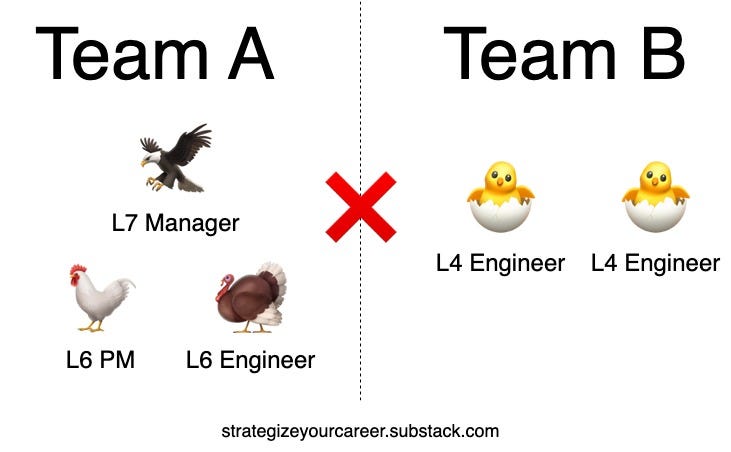
When involving different parties, ensure the same levels and roles for each. Avoid unbalanced meetings.
Never present a problem without a solution. Prepare for the follow-up questions. The SCQA framework comes in handy: Situation, Complication, Questions and Answers. Whenever a question is asked more than once in a review, write it in the FAQ section.