

Get the free AI Agent Building Blocks ebook when you subscribe:

Career stories are sold as a clean path. Pick a big goal, climb, and collect the promotion. Real engineering work does not work that way. You get incidents, shifting roadmaps, priority flips, and too much stuff you did not ask for. You could fight this chaos or design around it.
I have been setting yearly goals for more thna 5 years. Some were very big, like write a book or get promoted. The pattern was always the same: Strong start, then work chaos, then life chaos, and the goal quietly died. The problem is not only that I didn’t achieve my goals. The problem is that each failure made the next goal harder to believe in. That loss of trust hurts.
I understood it better when I learned about hyperbolic discounting. The further in the future rewards are, the more they lose to other distractions. That explained why a two year goal died the moment you receive a Slack message or another request. “You still have 2 years to work on it, it can wait”.
I needed a way to work with my brain, not against it. For me, the fix came from reading the book “Tiny Experiments”. It shifted my focus from achieving faster my goal to doing the right thing consistently.
It also solved a deeper issue. There are moments where I can’t even write a SMART goal. The problem is too ambiguous, or things change too fast that any goal would be outdated in a month. I can’t plan my way out of that. I needed something that let me pivot without losing all the work.
There are two valid goal styles for productive engineers. Top down goals with clear outcomes. Bottom up experiments that test what is worth doing. Both can succeed and both can fail. The aim of this post is to show you how both styles fit with the motivation equation so you can do more in less time without burning yourself out.
In this post, you’ll learn
Why motivation collapses for engineers even before the work gets hard.
When SMART goals help and when they quietly destroy momentum.
How to run tiny experiments that survive chaos and rebuild self trust.
How to switch between top down and bottom up modes.
How to tune expectancy, value, impulsiveness, and delay so goals actually stick.
Why goals for engineers die after week two
Engineering work can be interruption heavy. On call breaks your week. Incidents break your day. Dependencies break your plan. You do not work in a bubble. Planning assumes stability. Reality is unstable.
The motivation equation explains this gap.

Expectancy is your belief you can do the thing in your real environment.
Value is the meaning or fun you get now and later.
Impulsiveness is the pull to doomscroll or answer Slack.
Delay is how far the reward is.
Most big goals fail because delay is huge and expectancy is low. Hyperbolic discounting applies every time. A reward in two years isn’t more appealing than a Slack notification or jumping into solving some other problem.
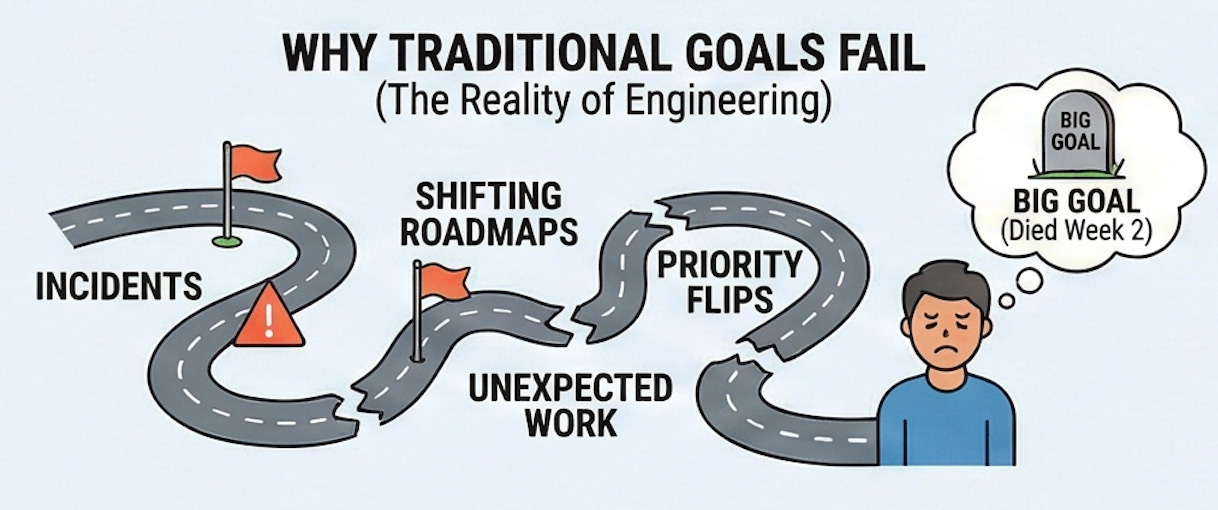
The failure pattern is simple: You set a big outcome. You know the delay is long and the chance of success is unclear. Impulsiveness is high because you do not feel progress. Value is mixed because the reward is too far to feel real. Your motivation goes down.
Top-down goals
SMART and CSI work when the environment is clear and the path is known. SMART means specific, measurable, achievable, relevant, and time bound. CSI means challenging, specific, immediate, and approach oriented. These are useful when your target is stable enough to hit.
Top down goals work best when the outcome is clear. Finish a course and use it for a feature by the end of the month. These goals fit the motivation equation when you tune them well.
Top down goals still fail if you turn them into rigid contracts. If you ignore context changes and protect the plan at all costs, it loses the point. Or you copy goals from others that do not fit your team.
When that happens the goal becomes a drag, not a guide.
Bottom-up goals
Tiny experiments give you momentum when top down planning is too heavy. A tiny experiment is a small, repeatable action that runs for a short period to test what works. It focuses on input, not output. You gain more information instead of being too rigid.
Success spirals start with simple commitments. Write for fifteen minutes each weekday. Run for twenty minutes per day. These goals are under your control. They do not depend on anyone else. When you hit them daily, you build a chain, you earn trust.
I like tiny experiments when the future is ambiguous. When I do not know how to make a SMART goal, I go with a short experiment. “For the next ten workdays I will spend ten minutes after standup updating my work log”. This is easier to commit to than comitting to “getting promoted”.
Tiny experiments map great to the motivation equation. Expectancy rises because the goal is so small you can always hit it, even on a bad day. Value rises because you can design experiments that are interesting or fun. Delay drops because experiments last one to four weeks. Impulsiveness drops because ten minutes is easy to start. These dynamics keep motivation alive.
These experiments fail when you overload yourself with micro goals. Or when you try things aimlessly and never turn experiments into outcomes.